
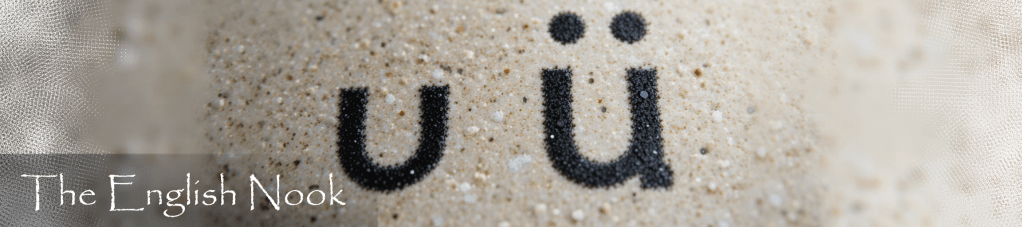
A Small Mark with a Big Purpose
If you’ve ever come across the word pingüino or vergüenza, you may have wondered — what’s that two-dot symbol doing over the u? This mark is called a diéresis (or crema), and although it’s rare in Spanish, it plays a very specific and important role.
For Spanish learners, mastering the diéresis helps ensure proper pronunciation and avoids silent mistakes. Let’s explore how it works, why it exists, and how to use it with confidence.
What Is the Diéresis and What Does It Do?
In Spanish, the diéresis (¨) is used only over the letter U and only in the combinations “gue” and “gui.” Its main function is to make the U pronounced when it normally would be silent.
✅ With diéresis: the U is pronounced
❌ Without it: the U is silent
Regular Pronunciation Rules: When the U Is Silent
In most Spanish words, “gue” and “gui” are pronounced like:
- /ge/ as in guerra (war)
- /gi/ as in guitarra (guitar)
⚠️ In these cases, the U is not pronounced at all.
| Word | Pronunciation | U sound? |
|---|---|---|
| guerra | /ˈɡe.ra/ | ❌ silent |
| guiso | /ˈɡi.so/ | ❌ silent |
With Diéresis: Make the U Speak!
Now let’s add the diéresis (¨) over the U:
- pingüino → /pinˈɡwi.no/ (penguin)
- vergüenza → /berˈɡwen.θa/ or /berˈɡwen.sa/ (shame)
- lingüística → /linˈɡwis.ti.ka/ (linguistics)
Here, the U is pronounced as part of the “w” sound — like “gw” in English.
| Word | With Diéresis | Sound |
|---|---|---|
| pingüino | ü → /w/ | pinguino would be incorrect |
| ambigüedad | ü → /w/ | means ambiguity |
| lingüística | ü → /w/ | not linguistica |
How to Know When to Use It
Use the diéresis (ü) only when two conditions are met:
- The word includes the combinations gue or gui, and
- The U must be audibly pronounced as part of the “w” sound (like “gw”).
📌 Do not use it with syllables like ga, go, gu, ge, gi, where the U is either naturally silent or pronounced according to regular rules.
🗣️ In fact, ge and gi are pronounced with a soft /x/ or /h/ sound (like the English “h” in huge), as in:
- gente → /ˈxen.te/ or /ˈhen.te/ (people)
- girar → /xiˈɾar/ or /hiˈɾar/ (to turn)
✅ Correct usage: pingüino, lingüística, antigüedad
❌ Incorrect usage: qüeso (should be queso), büngalo (should be bungaló)
What About Verbs and Conjugation?
Yes, you’ll also find the diéresis in verb forms, especially those with –guir infinitives like averiguar (to find out).
Examples:
- averigüé (I found out)
- atestigües (you testify)
Without the diéresis, these forms would break the pronunciation rules and be misread.
averigüé = I found out
averigue (without the dots) = would sound like /a-be-ree-ge/ instead of /a-be-ree-gwe/
Cultural Fun Fact: Why So Rare?
While common in German or French, the diéresis is very rare in Spanish, appearing only in a handful of words and verb forms. But despite its rarity, it’s essential when it does appear — it changes pronunciation completely!
Interestingly, Catalan and other co-official languages in Spain also use the diéresis, sometimes with different rules. But in standard Spanish, it sticks to ü in gue/gui.
Diéresis vs. Other Uses in Other Languages
In English, the symbol sometimes appears in names (Chloë, Noël) to indicate that two vowels should be pronounced separately — not as a diphthong.
In German (Müller, über), it changes the vowel sound entirely.
But in Spanish, the diéresis has one job only:
➡️ To pronounce the U in gue/gui as “w.”
The Small Mark That Speaks Loudly
Even though it appears quietly in the middle of a few words, the diéresis plays a loud and clear role in Spanish. It teaches you how spelling and pronunciation are connected — and how one tiny symbol can make a big difference.
For learners, it’s a fun discovery: you realize Spanish is not just about memorizing vocabulary — it’s about reading with precision, listening with care, and speaking with confidence.
So the next time you read pingüino or write averigüé, remember: those little dots are your guide to sounding natural and native.
Two dots, one mission: making the ‘u’ heard.
If you’ve read everything, please consider leaving a like, sharing, commenting, or all three!
YOU WILL ALSO LIKE:





 The English Nook
Leave a comment