The Germanic Roots
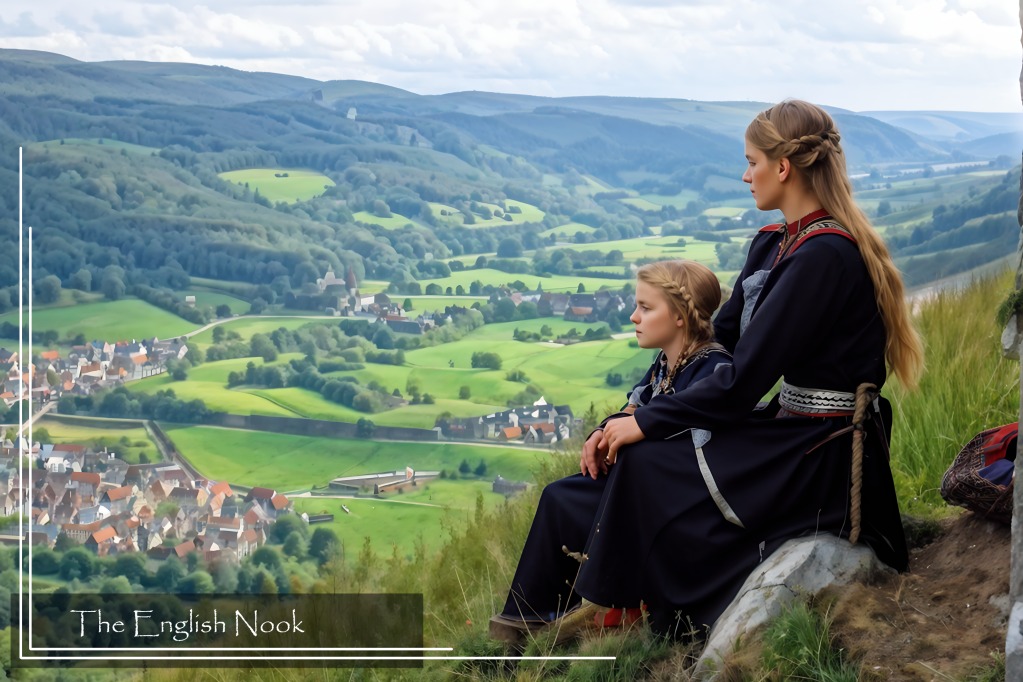
The “Germanic Roots” of Old English refers to the origin of the language in the Germanic dialects spoken by the Angles, Saxons, and Jutes, who migrated to Britain during the early Middle Ages. These tribes came from regions in what is now Denmark, northern Germany, and the Netherlands. Their languages were part of the West Germanic branch of the Germanic language family, which also includes Old High German, Old Frisian, and Old Saxon.
1. Language Family:
Old English is a member of the West Germanic branch of the broader Germanic language family, which also includes languages like Old High German, Old Frisian, and Old Saxon. This family shares a common ancestry that diverged from the Proto-Germanic language around the 1st century BC. The Germanic tribes that brought their dialects to Britain—the Angles, Saxons, and Jutes—spoke languages that had already evolved from this Proto-Germanic origin. As a result, Old English retained many features that are still recognizable in other Germanic languages. For instance, the Old English word “brōþor” (brother) is cognate with the Old High German “bruoder” and the Old Norse “bróðir,” highlighting the shared linguistic heritage. This linguistic kinship is crucial for understanding how Old English fits into the wider Germanic language family and provides a foundation for tracing the evolution of English from its earliest stages.
2. Vocabulary:
The vocabulary of Old English was heavily influenced by its Germanic roots, with a significant portion of its lexicon derived directly from the dialects of the Angles, Saxons, and Jutes. Words related to daily life, nature, and kinship are prime examples of this Germanic inheritance. For instance, the Old English word “hām” (home) shares its origin with the Old High German “heim” and the Old Norse “heimr.” Similarly, “cyning” (king) is linked to the Old High German “kuning” and the Old Norse “konungr.” These words are not just linguistic artifacts; they reflect the central aspects of Anglo-Saxon life, emphasizing the importance of home, kinship, and leadership. The Germanic vocabulary of Old English laid the groundwork for many modern English words, preserving these essential elements across centuries.
3. Grammatical Structure:
Old English’s grammatical structure is a clear reflection of its Germanic roots, characterized by features common to the West Germanic languages. The language had a highly inflected grammar, meaning that the endings of words changed depending on their grammatical role in a sentence. For example, nouns were inflected for four cases: nominative, accusative, genitive, and dative, with each case indicating a different function, such as subject, object, possession, or indirect object. An Old English sentence like “þe cyning sealde þam ceorle aenne hring” (The king gave a ring to the churl) shows this structure, where “þe cyning” (the king) is nominative, “þam ceorle” (to the churl) is dative, and “aenne hring” (a ring) is accusative. Additionally, verbs in Old English were conjugated to reflect tense, mood, person, number, and voice, a complexity that modern English has largely simplified. Understanding this grammatical structure is essential for grasping how Old English functioned and how its Germanic roots influenced the syntax and morphology of the language.
4. Sound Changes:
The sound system of Old English also reflects its Germanic roots, particularly through key phonological changes inherited from Proto-Germanic. One of the most notable is Grimm’s Law, which describes a series of shifts in the consonant sounds from Proto-Indo-European to Proto-Germanic. For example, the Proto-Indo-European p, t, k became the Germanic f, þ, h in words like “faeder” (father), “þū” (you), and “hūs” (house). Another important sound change is the West Germanic consonant shift, which affected the pronunciation of certain consonants, making Old English distinct yet still related to other Germanic languages. These sound changes not only define the phonetic character of Old English but also link it to its Germanic origins, illustrating how ancient linguistic shifts have left a lasting imprint on the language.
5. Cultural Influence:
The Germanic roots of Old English are not limited to language alone; they extend deeply into the culture and social structures of Anglo-Saxon England. The values and traditions of the Germanic tribes—such as the warrior ethos, the concept of loyalty to one’s lord, and the importance of kinship—are all embedded in the language. This cultural influence is vividly reflected in Old English literature, where themes like heroism, fate (wyrd), and honor are prominent. The epic poem “Beowulf,” for example, exemplifies these themes, portraying the hero as a figure who embodies the virtues of strength, courage, and loyalty, central to Germanic culture. Understanding the cultural context of Old English enhances our appreciation of the language as more than just a means of communication; it was a vehicle for expressing the values and identity of the Anglo-Saxon people, deeply rooted in their Germanic heritage.
In Summary
The Germanic roots of Old English are fundamental to understanding the language’s development and its place within the broader history of English. By examining its language family, vocabulary, grammatical structure, sound changes, and cultural influence, we gain insight into how Old English emerged from the Germanic dialects of the Angles, Saxons, and Jutes and evolved into a distinct language that laid the foundation for modern English. These roots are not just historical curiosities; they are the building blocks of the language we speak today, offering a window into the linguistic and cultural origins of English.
The Germanic roots of Old English not only shaped its structure and vocabulary but also forged a linguistic legacy that resonates through the English language today.
If you’ve read everything, please consider leaving a like, sharing, commenting, or all three!
YOU WILL ALSO LIKE:







 The English Nook
Leave a comment