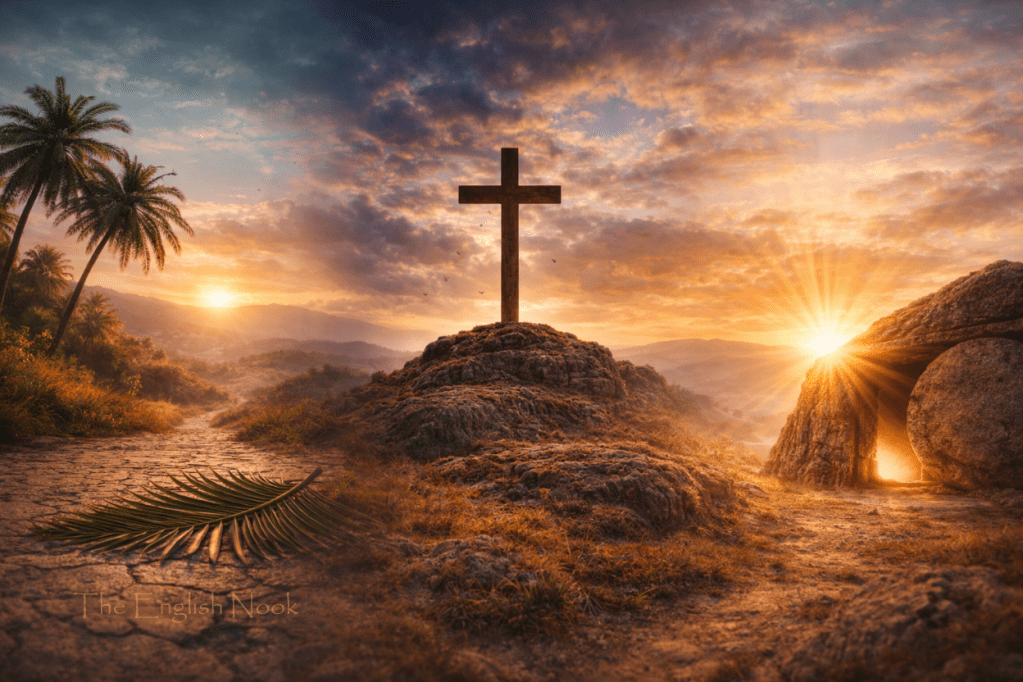
🌿 Beyond Basic Easter Vocabulary 🌿
Some words describe a story. Others describe what people believe, what they fear, and what they hope for.
In basic English, we learn words like Easter, church, holiday, spring, and egg. These words are useful, but they only describe the surface of the celebration.
However, Easter and Holy Week are not only events on a calendar — they are part of a story, a tradition, and a set of ideas that have existed for centuries. The language used during this time is full of words connected to faith, sacrifice, forgiveness, hope, and rebirth.
At a higher level, learning vocabulary is not only about naming objects, but about understanding the ideas and beliefs behind them. Many of the words connected to Holy Week describe things we cannot touch — ideas, beliefs, and symbols that have shaped cultures and traditions around the world.
This guide will help you learn and understand some of the most important words connected to Easter and Holy Week.
✝️ Easter & Holy Week Vocabulary (B2 Level) ✝️
1. Lent
IPA: /lent/
Spanish: Cuaresma
Definition: The 40-day period before Easter, traditionally a time of reflection or sacrifice.
Example: Many people give something up during Lent.
Translation: Muchas personas dejan algo durante la Cuaresma.
2. Palm Sunday
IPA: /pɑːm ˈsʌndeɪ/
Spanish: Domingo de Ramos
Definition: The Sunday before Easter, marking the beginning of Holy Week.
Example: Palm Sunday marks the beginning of Holy Week.
Translation: El Domingo de Ramos marca el inicio de la Semana Santa.
3. Maundy Thursday
IPA: /ˈmɔːndi ˈθɜːrzdeɪ/
Spanish: Jueves Santo
Definition: The Thursday before Easter, associated with the Last Supper.
Example: Many churches hold special services on Maundy Thursday.
Translation: Muchas iglesias realizan servicios especiales el Jueves Santo.
4. Good Friday
IPA: /ɡʊd ˈfraɪdeɪ/
Spanish: Viernes Santo
Definition: The day commemorating the crucifixion.
Example: Good Friday is a day of reflection and silence.
Translation: El Viernes Santo es un día de reflexión y silencio.
5. Resurrection
IPA: /ˌrezəˈrekʃən/
Spanish: Resurrección
Definition: The act of coming back to life.
Example: Easter celebrates the idea of resurrection.
Translation: La Pascua celebra la idea de la resurrección.
6. Crucifixion
IPA: /ˌkruːsɪˈfɪkʃən/
Spanish: Crucifixión
Definition: Execution on a cross.
Example: The crucifixion is central to the Easter story.
Translation: La crucifixión es central en la historia de la Pascua.
7. Tomb
IPA: /tuːm/
Spanish: Tumba
Definition: A place where a body is placed after death.
Example: According to the story, the tomb was empty on Easter morning.
Translation: Según la historia, la tumba estaba vacía en la mañana de Pascua.
8. Sacrifice
IPA: /ˈsækrɪfaɪs/
Spanish: Sacrificio
Definition: Giving up something important for a reason.
Example: The story of Easter is often connected to sacrifice.
Translation: La historia de la Pascua suele estar conectada con el sacrificio.
9. Forgiveness
IPA: /fərˈɡɪvnəs/
Spanish: Perdón
Definition: The act of forgiving someone.
Example: Forgiveness is an important theme in the story.
Translation: El perdón es un tema importante en la historia.
10. Faith
IPA: /feɪθ/
Spanish: Fe
Definition: Strong belief or trust in something.
Example: Faith can give people strength during difficult times.
Translation: La fe puede dar fuerza a las personas en tiempos difíciles.
11. Dawn
IPA: /dɔːn/
Spanish: Amanecer
Definition: The first light of day.
Example: Many Easter celebrations happen at dawn.
Translation: Muchas celebraciones de Pascua ocurren al amanecer.
12. Rebirth
IPA: /ˌriːˈbɜːrθ/
Spanish: Renacimiento
Definition: Being born again; a new beginning.
Example: Spring is often seen as a symbol of rebirth.
Translation: La primavera suele verse como un símbolo de renacimiento.
13. Hope
IPA: /hoʊp/
Spanish: Esperanza
Definition: The feeling that something good will happen.
Example: Easter is often connected to hope.
Translation: La Pascua suele estar conectada con la esperanza.
14. Procession
IPA: /prəˈseʃən/
Spanish: Procesión
Definition: A ceremonial movement of people.
Example: Many cities hold religious processions during Holy Week.
Translation: Muchas ciudades realizan procesiones durante la Semana Santa.
15. Candle
IPA: /ˈkændəl/
Spanish: Vela
Definition: A symbol of light in darkness.
Example: Candles are often used during night ceremonies.
Translation: Las velas se usan a menudo durante ceremonias nocturnas.
🕯️ Easter Morning
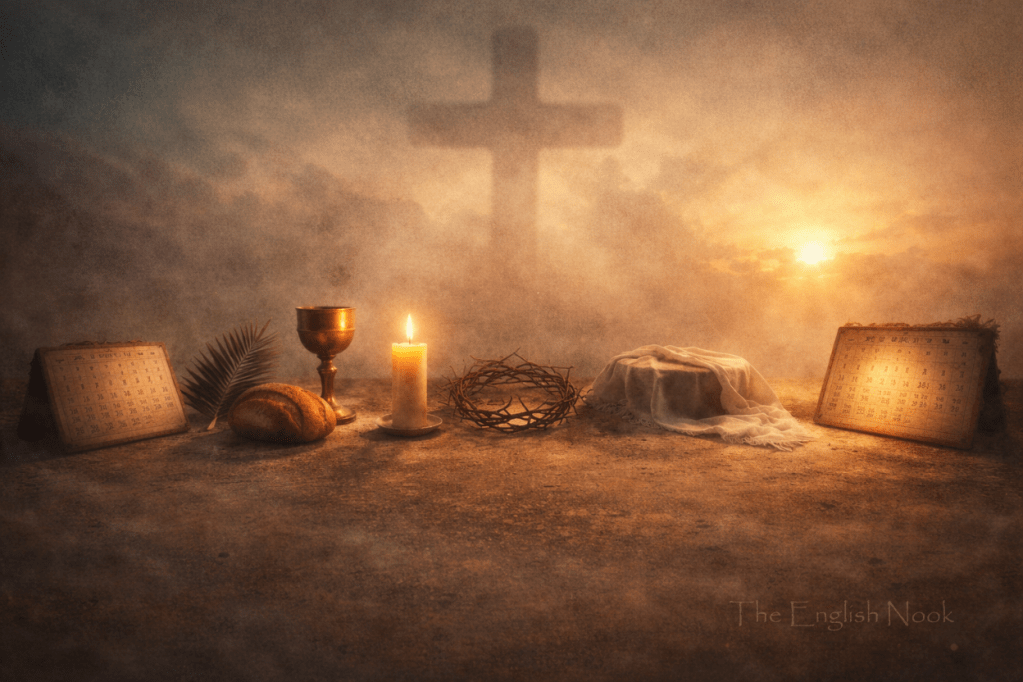
During Holy Week, many people think about sacrifice, forgiveness, and faith. The story moves from the cross and the tomb to the idea of resurrection and rebirth. This is why Easter is often connected to dawn, spring, and hope. These symbols remind people that after darkness, light can return, and after difficult times, new life can begin.
🇪🇸 Leer en español — Haz clic para abrir
La Mañana de Pascua
Durante la Semana Santa, muchas personas piensan en el sacrificio, el perdón y la fe. La historia pasa de la cruz y la tumba a la idea de la resurrección y el renacimiento. Por eso la Pascua suele estar conectada con el amanecer, la primavera y la esperanza. Estos símbolos recuerdan que después de la oscuridad, la luz puede volver.
🇵🇹 Ler em português — Clique para abrir
A Manhã de Páscoa
Durante a Semana Santa, muitas pessoas pensam em sacrifício, perdão e fé. A história passa da cruz e do túmulo para a ideia de ressurreição e renascimento. Por isso a Páscoa costuma estar ligada ao amanhecer, à primavera e à esperança. Esses símbolos lembram que depois da escuridão, a luz pode voltar.
The Language of Holy Week
At a basic level, Easter is a holiday in spring.
At a deeper level, however, the language of Holy Week is full of words like sacrifice, forgiveness, faith, rebirth, and hope — words that describe ideas rather than objects.
These are not words you can touch, but they are words that have shaped stories, traditions, and beliefs for centuries. Many of them appear not only in religion, but also in literature, films, and everyday language.
When you learn vocabulary like this, you are not only learning English — you are learning how people describe meaning, difficulty, hope, and new beginnings.
Some words describe the world we see.
Others describe the world we believe in.
And sometimes, those invisible words shape our lives more than the visible world ever could.
✍️ Writing Challenge — Holy Week
Write a short paragraph (120–150 words) describing a Holy Week or Easter scene.
You can describe:
- a procession
- a church
- candles at night
- Easter morning
- spring landscape
- a moment of reflection
Try to use at least 5 words from the vocabulary list.
Language becomes powerful when description becomes precise.
📚 Vocabulary Quick Reference — English | Spanish | Portuguese
| English | Spanish | Portuguese |
|---|---|---|
| Lent | Cuaresma | Quaresma |
| Palm Sunday | Domingo de Ramos | Domingo de Ramos |
| Maundy Thursday | Jueves Santo | Quinta-feira Santa |
| Good Friday | Viernes Santo | Sexta-feira Santa |
| Resurrection | Resurrección | Ressurreição |
| Crucifixion | Crucifixión | Crucificação |
| Tomb | Tumba | Túmulo |
| Sacrifice | Sacrificio | Sacrifício |
| Forgiveness | Perdón | Perdão |
| Faith | Fe | Fé |
| Dawn | Amanecer | Amanhecer |
| Rebirth | Renacimiento | Renascimento |
| Hope | Esperanza | Esperança |
| Procession | Procesión | Procissão |
| Candle | Vela | Vela |
Si has leído todo, por favor considera dejar un “me gusta”, compartir, comentar, ¡o hacer las tres cosas!
¿Necesitas ayuda con tu aprendizaje de inglés? Ve a la sección de contacto y envíame un mensaje; ¡te responderé lo antes posible para ayudarte!
Stay in the Nook!

 The English Nook
Leave a comment