Why Holy Week Is Not Exactly a Week
An eight-day week that begins and ends with a Sunday
We think a week is seven days.
But some traditions were never meant to fit inside a calendar.
The Week That Is Not a Week
We are used to thinking of a week as seven days — Monday to Sunday, workdays and weekend, a neat and familiar cycle. But Holy Week does not follow this structure. In the traditional Christian calendar, Holy Week begins on Palm Sunday and ends on Easter Sunday. If you count the days, that is not seven days, but eight.
So why do we still call it a week?
The answer is not a mistake in counting. It is a different way of understanding time.
The Idea of the Octave
In older Christian traditions, the most important celebrations did not last just one day. They lasted eight days, a period known as an octave. Easter was so important that it was celebrated not only on one Sunday, but for eight days — from Palm Sunday to the following Sunday.
The number eight had symbolic meaning. Seven days represented the ordinary cycle of time — the week of creation, the rhythm of normal life. But the eighth day represented something beyond the ordinary cycle: renewal, resurrection, and a new beginning.
In this way, Holy Week was never meant to be just a unit of time. It was meant to be a cycle of meaning.
From Calendar Time to Meaningful Time
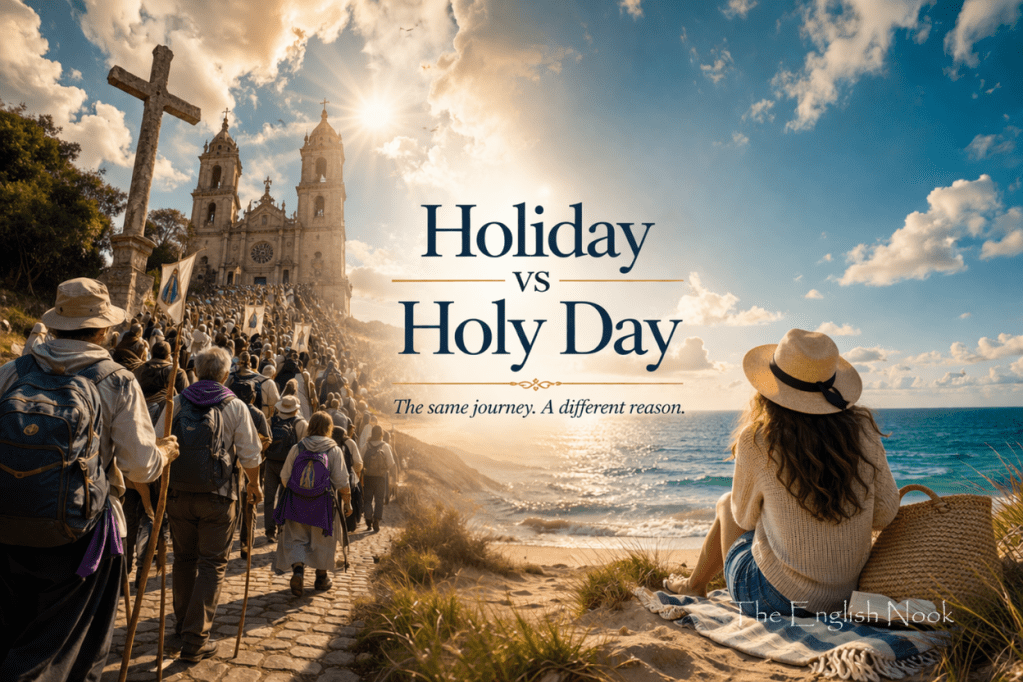
Today, most of us experience holidays as a break from work, a pause in routine, a moment to rest or travel. But historically, holy days were not simply days off — they were days set apart. Time was not measured by productivity, but by memory, ritual, and community.
Holy Week, then, is called a week not because it has seven days, but because it forms a complete story: it begins with an arrival, moves through betrayal and loss, and ends with renewal. It is a narrative measured in events, not in numbers.
A Different Way of Measuring Time
We measure most weeks in hours, schedules, and deadlines.
But some traditions measured time differently — in stories, in rituals, in shared memory.
Holy Week is one of those traditions.
It is not exactly a week.
It is a reminder that not all time is counted the same way.
Words That Still Remember
Interestingly, the word “holiday” itself comes from “holy day.”
Over time, the meaning changed, but the word remained. Language often works this way — it keeps old ideas inside modern words, like a small piece of history hidden in everyday speech.
Holy Week is similar. The structure remained, even when many people forgot why it was eight days long. The calendar kept the shape of the tradition, even when the meaning became less visible.
Language remembers.
Calendars remember.
Even when people forget.
—
Not all weeks are measured in days.
Some are measured in memory and meaning.
If you’ve read everything, please consider leaving a like, sharing, commenting, or all three!
Stay in the Nook:



 The English Nook
Leave a comment