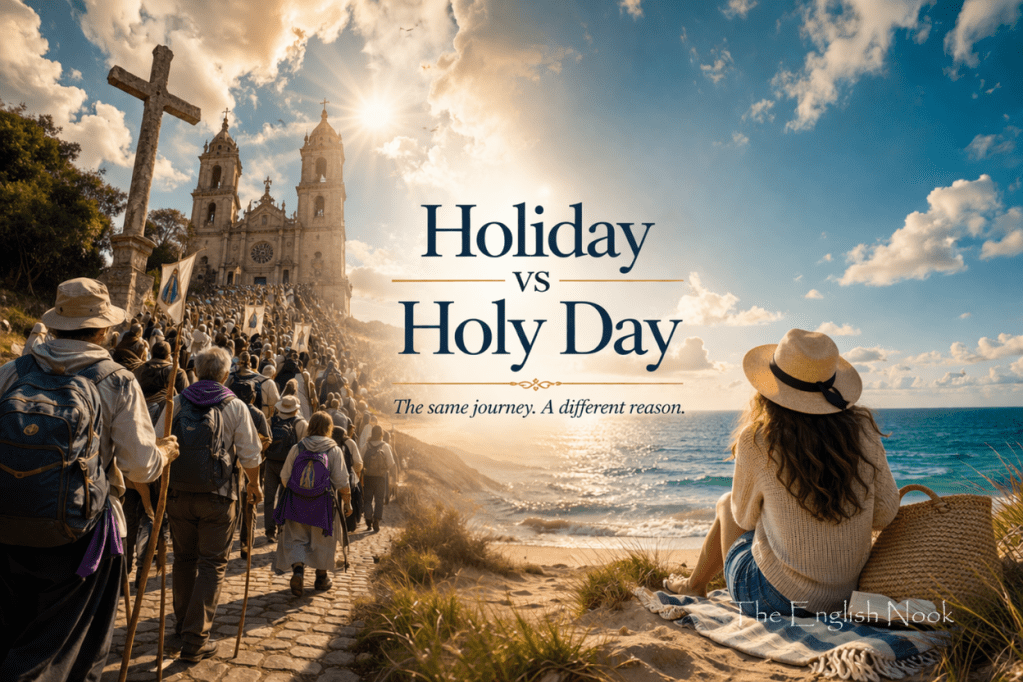

A Word That Changed Its Meaning
At first glance, holiday and holy day look almost identical. This is not a coincidence. In fact, they were once the same word.
But as society changed, the word changed too. What was once a holy day — a day set aside for ritual, memory, and community — slowly became what we now call a holiday, a day of rest, travel, or celebration.
The story of these two words is a small example of how language preserves history, even when we no longer notice it.
The Difference
| Word | Meaning |
|---|---|
| Holiday | A day of rest, celebration, or vacation |
| Holy day | A religious festival or sacred day |
Examples:
- Christmas is a holy day for Christians.
- Christmas Day is also a public holiday in many countries.
- We are going on holiday next month.
- Easter is an important holy day in the Christian calendar.
From Holy Day to Holiday
The word holiday comes from holy day.
Hundreds of years ago, many days off were not for travel, shopping, or entertainment — they were for:
- Religious celebrations
- Festivals
- Rituals
- Commemorations
- Community gatherings
People stopped working because the day was holy, not because they needed a vacation.
Over time, the pronunciation changed:
holy day → holiday
And the meaning slowly changed too.
| Before | Now |
|---|---|
| Holy day = religious day | Holiday = day off / vacation |
But the old meaning never completely disappeared. Many modern holidays still come from old religious calendars, such as:
- Christmas
- Easter
- All Saints’ Day
- Epiphany
- Ramadan (in Muslim countries)
- Diwali (in India)
- Hanukkah (in Jewish tradition)
So when we say holiday, we are still using a word that originally meant holy day.
Example Sentences
- Good Friday is a holy day in many Christian traditions.
- In many countries, Good Friday is a public holiday.
- For many people, Christmas is both a holy day and a holiday.
- The word holiday originally came from holy day.
Quick Practice
Choose: holiday or holy day (use the plural form if necessary)
- Easter is an important ______ in the Christian calendar.
- We are going on ______ to the south of Chile next week.
- In the past, many European ______ were connected to the church calendar.
- Diwali is a religious ______ celebrated in India.
- After months of work, he really needed a ______.
Answers:
- holy day
- holiday
- holidays
- holy day
- holiday
A Final Note
Many of the days we now call holidays were once holy days. They were not originally meant for travel or entertainment, but for memory, ritual, and community.
In older calendars, these days marked important moments in the year — moments when people stopped their daily work not to escape life, but to recognize it, to give it structure, meaning, and rhythm.
The word holiday still carries its old meaning inside it — quietly, almost invisibly — a small piece of history hidden in everyday language.
A reminder that not all days off were meant for escape.
Some were meant for memory.
Not all holidays began as vacations.
Some began as rituals.
Some were meant for memory.
→ Profundiza más tu Inglés!
→ Lee una Historia
→ Explore English/Spanish sessions



 The English Nook
Leave a comment