From Sentences to Reasoning
As learners progress in Spanish, their sentences naturally become longer and their ideas more complex. At first, simple connectors such as y, pero, or porque are enough to link thoughts together. However, as conversations become more sophisticated, these basic connectors often prove insufficient.
At the advanced-intermediate level, learners begin using nuanced connectors — expressions that allow them to clarify relationships between ideas, introduce contrast, explain consequences, or refine an argument.
For English-speaking learners, this stage represents an important shift. Communication is no longer limited to expressing individual thoughts. Instead, Spanish becomes a tool for organizing reasoning.
Nuanced connectors help transform a sequence of sentences into a coherent line of thought.
Expressing Contrast
One of the most common uses of advanced connectors is to introduce contrast between ideas.
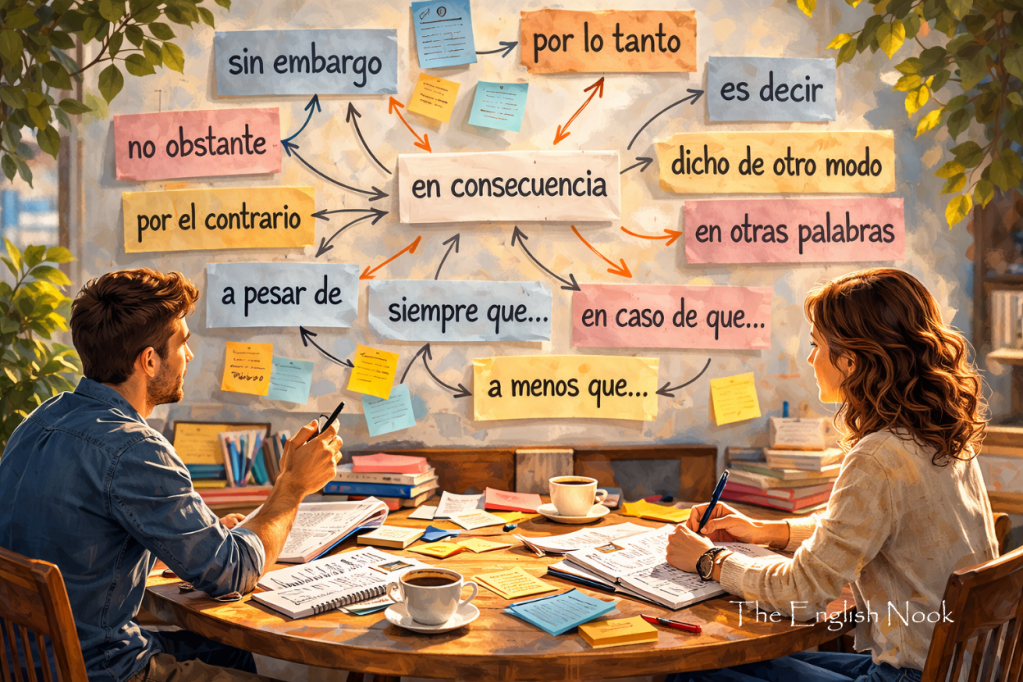
Sin embargo… — However…
No obstante… — Nevertheless…
A pesar de… — Despite…
Por el contrario… — On the contrary…
Examples:
El proyecto parecía prometedor; sin embargo, surgieron varios problemas inesperados.
Muchos creen que la tecnología simplifica la vida; no obstante, también introduce nuevas complejidades.
A pesar de las dificultades iniciales, el equipo logró completar el trabajo.
These connectors allow speakers to recognize complexity rather than present ideas as absolute.
Showing Cause and Consequence
Nuanced connectors are also essential for explaining relationships between events and decisions.
Por lo tanto… — Therefore…
En consecuencia… — Consequently…
Como resultado… — As a result…
Por esta razón… — For this reason…
Examples:
El mercado ha cambiado significativamente; por lo tanto, las empresas deben adaptarse.
La inversión en educación aumentó; en consecuencia, mejoraron los resultados académicos.
La comunicación fue deficiente; como resultado, surgieron malentendidos.
These expressions help organize explanations logically and guide the listener through the reasoning process.
Clarifying and Reformulating Ideas
When discussing complex topics, speakers often need to restate ideas in clearer or more precise terms.
Es decir… — That is… / In other words…
Dicho de otro modo… — Put differently…
En otras palabras… — In other words…
Examples:
La decisión requiere un cambio estructural; es decir, una transformación profunda del sistema.
El problema no es técnico; dicho de otro modo, es un problema de organización.
El proyecto necesita más tiempo; en otras palabras, el calendario original era demasiado optimista.
These connectors help maintain clarity while discussing more complex ideas.
Introducing Conditions
Some connectors allow speakers to explore possibilities and conditions.
Siempre que… — Provided that…
En caso de que… — In case…
A menos que… — Unless…
Examples:
El acuerdo será viable siempre que ambas partes cooperen.
En caso de que surjan problemas, revisaremos el plan.
El proyecto continuará a menos que cambien las circunstancias.
These expressions allow arguments to incorporate nuance and hypothetical reasoning.
Why These Connectors Matter
Nuanced connectors play a crucial role in advanced communication. They allow speakers to structure arguments, guide listeners through complex explanations, and express relationships between ideas with precision.
Without them, speech can sound fragmented or overly simple. With them, ideas become organized and persuasive.
For learners entering the advanced-intermediate level, mastering these connectors is not simply about vocabulary. It is part of learning how to structure thought in Spanish.
To Wrap Up
Nuanced connectors are the invisible architecture of complex language. They shape how ideas are contrasted, developed, and connected.
As learners become comfortable with these expressions, Spanish stops being a series of isolated sentences and begins to function as a coherent system of reasoning.
At that point, the language no longer merely conveys information.
It structures thought.
Master the connectors—and Spanish stops linking sentences and starts shaping thought.
The next time you connect two ideas in Spanish,
don’t just link the sentences —
notice how the connector guides the thought.
→ Continue Your Spanish Journey
→ Read a story
→ Explore English/Spanish sessions




 The English Nook
Leave a comment