Living Dead Girl
When Lila died, the doctors were very clear about it.
“Time of death,” one of them said, checking his watch, “2:17 a.m.”
Everyone nodded solemnly.
Lila also nodded, but nobody noticed because she was technically supposed to be dead.
The first strange thing happened three hours later.
At 5:24 a.m., Lila sat up.
She looked around the hospital room.
“Hmm,” she said.
Her voice sounded a little dry. Like someone speaking after eating too many crackers.
She checked her wrist.
No pulse.
She checked again.
Still no pulse.
“Well,” she said thoughtfully, “that seems inconvenient.”
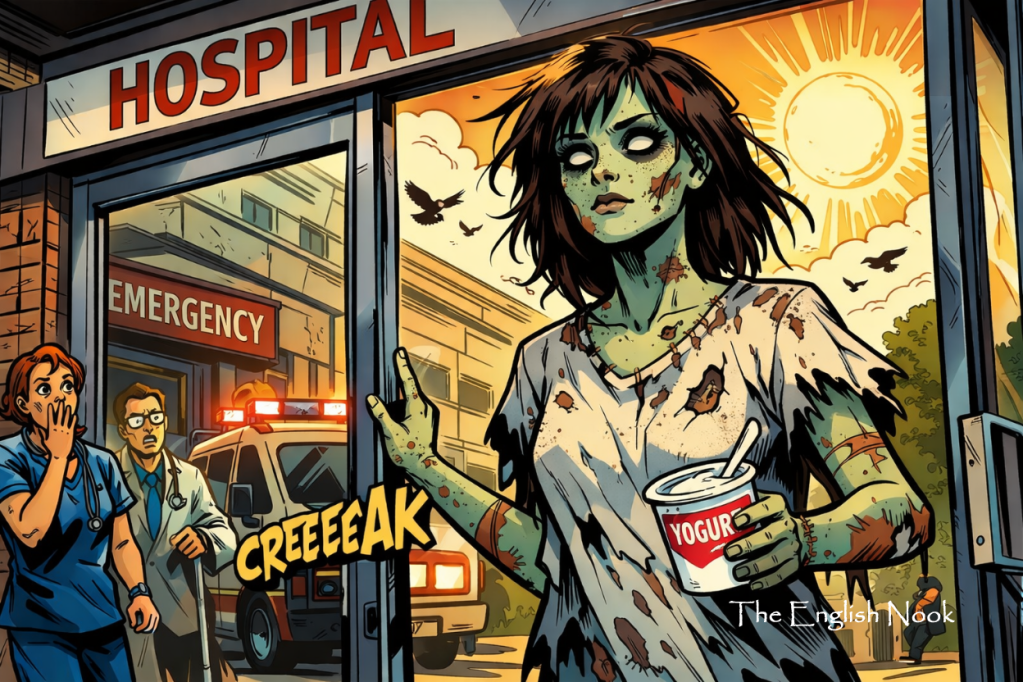
Getting out of the hospital was surprisingly easy.
If you walk slowly enough and look confused, people assume you belong somewhere.
Lila shuffled past two nurses, a janitor, and a vending machine that refused to give her a chocolate bar.
The vending machine, she decided, was the most hostile encounter of the morning.
By noon, Lila had reached an important realization:
Being a zombie was mostly administrative.
For example:
- Doors were heavy.
- Crossing streets took forever.
- And people screamed a lot, which felt unnecessary.
The screaming started at the grocery store.
Lila only wanted yogurt.
She stood in the dairy aisle, considering strawberry versus vanilla, when a woman turned the corner and froze.
They looked at each other.
The woman screamed.
Very loudly.
Lila blinked.
“Is it the yogurt?” she asked politely.
Soon the store manager arrived with a broom.
“Zombie!” he shouted.
“Yes,” Lila said.
“Well… you can’t be here!”
“Why not?”
“You’re undead!”
Lila thought about that.
“Yes,” she agreed.
“But I still need yogurt.”
Word spread quickly.
By the afternoon, half the town had gathered outside the grocery store.
Some people held torches.
One man had brought a medieval helmet for some reason.
The mayor stepped forward nervously.
“Living dead girl,” he said, “what are your intentions?”
Lila considered the question carefully.
“Mostly snacks,” she said.
“And maybe a nap.”
The crowd murmured.
This was not the terrifying declaration they had expected.
The mayor cleared his throat.
“You’re not planning to… eat brains?”
Lila wrinkled her nose.
“Have you met people?”
“Fair point,” someone in the back said.
Eventually they reached an agreement.
Lila could stay in town under three conditions:
- No eating citizens.
- No terrifying the elderly before 9 a.m.
- Always pay for yogurt.
Lila accepted.
It seemed reasonable.
Life as a zombie turned out to be peaceful.
Lila walked slowly through town.
People waved.
Children asked questions like:
“Do your arms fall off?”
“Sometimes,” she said.
“Cool.”
And every Tuesday morning, Lila visited the grocery store.
By then, the town had mostly gotten used to her.
Children waved.
Dogs sniffed her suspiciously, then decided she was acceptable.
The elderly nodded to her with the calm politeness reserved for weather, traffic, and other things nobody can quite explain.
At the checkout, the cashier would ring up her yogurt and smile.
“Morning, living dead girl.”
“Morning,” Lila replied.
She paid carefully—counting the coins a bit slower than most people—and stepped outside into the sunlight.
The strange thing about being dead, Lila had discovered, was that very little actually changed.
The sun still warmed the pavement.
People still hurried somewhere important.
Someone always seemed to be arguing about something trivial.
And everyone behaved as if they had endless time.
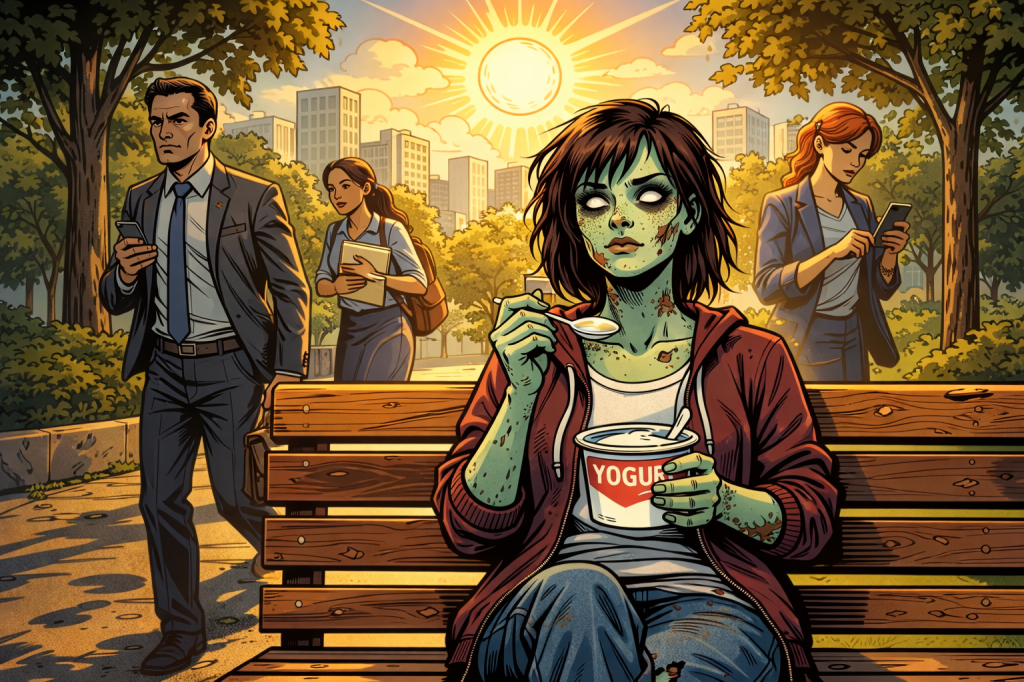
Lila stood on the sidewalk for a moment, holding her yogurt.
She had died once already.
It had been brief. Quiet. Almost boring.
What surprised her most was how similar the world looked afterward.
The same sky.
The same buildings.
The same people walking past, busy and distracted, carrying invisible worries like heavy bags.
Sometimes they looked at her and whispered:
“The living dead girl.”
But Lila wasn’t sure that was quite right.
Because as she watched the crowd rushing past—faces tense, eyes fixed somewhere far ahead—she sometimes had the peculiar feeling that she might be the only one who had actually noticed something important.
She had already lost life once.
Which meant, strangely enough, that she no longer had to be afraid of it ending.
She opened the yogurt.
Took a slow spoonful.
And watched the world move around her.
For the first time in a long time, Lila felt quietly, unmistakably alive.
🧟♀️
🤍💀 She died once—so she finally learned how to live. 🧟♀️🖤
Note:
Thank you for reading “Living Dead Girl”! This is a story in a series created for avid readers and English learners who want to enjoy captivating tales while practicing their language skills. Stay tuned for more stories and language tips to enhance your journey!
Explore more short stories in English and Spanish by visiting the section:
Short Stories / Cuentos Cortos
When the world feels dull, your mind restless, or your heart heavy, let a story be your escape. Just one page, one sentence, one word—and suddenly, you’re somewhere new, where imagination breathes life into the ordinary and turns the simplest moments into magic.
“Liked it? Smash that like button! 🧟♀️✨”



 The English Nook
Leave a comment