On Borrowing and Becoming
We like to think of languages as solid things.
Boundaries. Flags. Dictionaries.
But languages are porous.
They leak into each other.
English, especially, has never been pure. It has always borrowed. From French. From Latin. From Norse. From Hindi, Arabic, Spanish. From wherever ships landed and ideas crossed.
It did not grow by protecting itself.
It grew by absorbing.
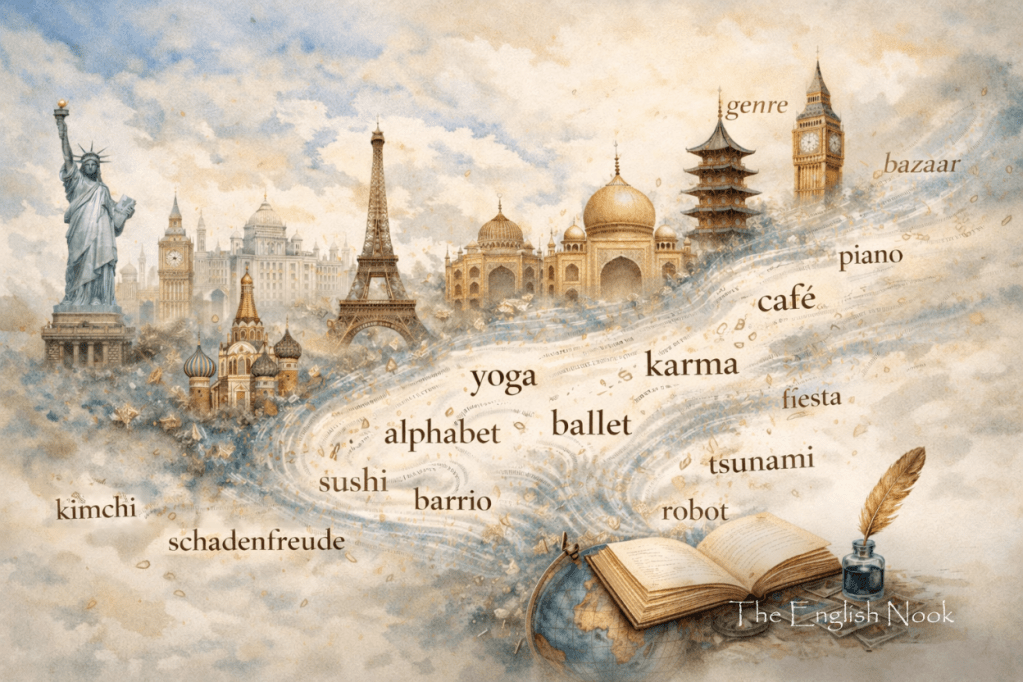
When English says ballet, it is remembering France.
When it says algebra, it carries Arabic thought.
When it says patio or guerrilla, it carries Spanish echoes.
When it says yoga or karma, it borrows entire philosophies.
These words are not decorations. They are cultural footprints.
And over time, we stop hearing them as foreign. They become natural. Ordinary. Ours.
That’s the quiet transformation.
A borrowed word enters cautiously. It feels different at first — pronounced carefully, sometimes awkwardly. Then it settles. It adapts to new sounds. New rhythms. It loses its accent.
Eventually, we forget it was ever borrowed at all.
And something else happens.
We change with it.
When a language adopts a word, it is not just expanding vocabulary. It is expanding perspective. Each borrowed word brings with it a way of seeing the world — a culinary tradition, a scientific idea, a spiritual concept, a social structure.
Loanwords are small acts of cultural contact.
They tell us that language is not isolation. It is exchange.
And if that’s true for languages, it may also be true for us.
Think about the words that feel most like you. The ones you reach for instinctively. Some of them may not have originated in your “own” language at all. Yet they shape your thoughts, your humor, your emotional expression.
We borrow more than words.
We borrow ways of being.
English, perhaps more than most languages, is built on this openness. It did not defend itself against foreign influence; it folded it in. That flexibility is part of its strength. It can speak in Germanic bluntness, in French elegance, in Latin abstraction — sometimes all in the same sentence.
Its identity is layered.
And maybe that is what makes it modern.
There is something humbling about realizing that the language we call ours is, in many ways, a mosaic. It is assembled from encounters — invasions, trade routes, colonization, migration, curiosity.
Every borrowed word is evidence that cultures touched.
Some gently.
Some violently.
But they touched.
When we speak, we are carrying that history forward, even if we don’t know it.
So perhaps purity in language is a myth.
Perhaps what makes a language alive is not what it protects, but what it is willing to take in.
And perhaps the same is true for us.
Because the words we borrow slowly shape the selves we become.
The words you inherit shape you.
The words you adopt reshape you.
Which ones are quietly becoming you?
→ Continue wandering
→ Read a story
→ Explore English/Spanish sessions




 The English Nook
Leave a comment