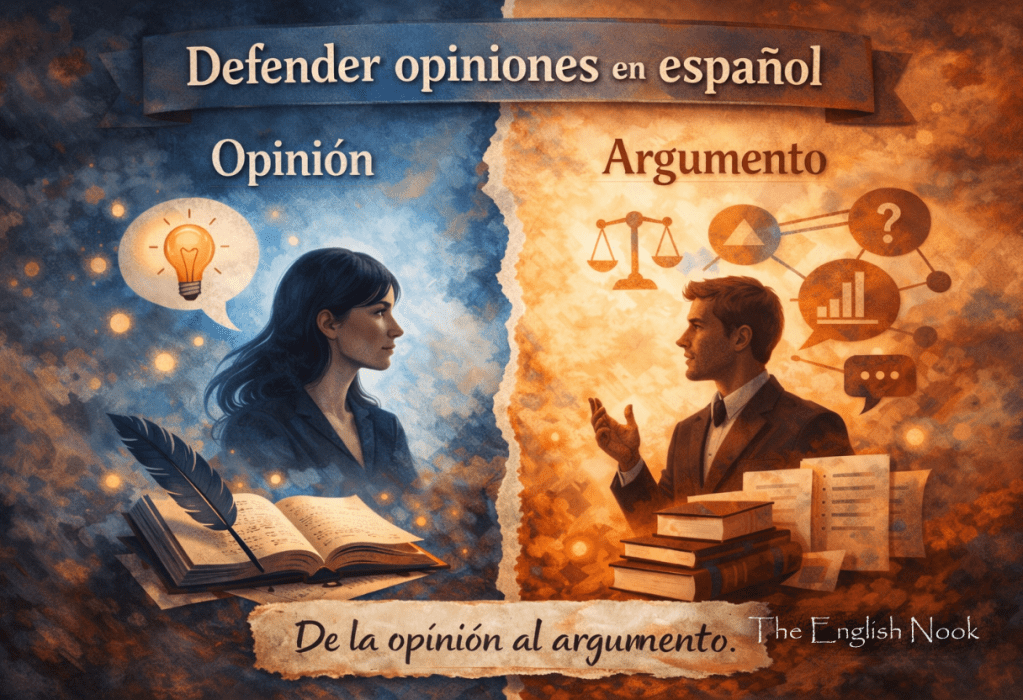

From Opinion to Argument in Spanish
At an intermediate to upper-intermediate stage of learning Spanish, grammar accuracy and vocabulary expansion are no longer the primary obstacles. The real shift occurs when learners begin to think through the language — when they can not only express opinions, but defend them with clarity, nuance, and structure.
For English-speaking learners, this stage often feels challenging. Spanish argumentation tends to rely more heavily on connective phrases, explicit reasoning, and carefully structured progression. A simple statement of preference is rarely enough in formal or semi-formal contexts.
Defending an opinion in Spanish does not mean arguing aggressively or insisting on being right. Rather, it involves presenting a viewpoint thoughtfully, supporting it with reasons, acknowledging alternative perspectives, and reaching a reasoned conclusion.
It is both a linguistic skill and a cognitive one.
Moving Beyond Simple Opinions
At lower levels, learners might say:
No me gusta esta idea.
(I don’t like this idea.)
At B2 level and above, the same thought becomes more developed:
No me convence esta propuesta porque, aunque tiene aspectos positivos, considero que sus consecuencias a largo plazo podrían ser problemáticas.
This expansion introduces:
- Justification (porque…)
- Concession (aunque…)
- Qualification (podrían ser…)
This layered structure is essential in advanced communication.
Core Structures for Defending Opinions in Spanish
1. Stating Your Position
These expressions allow you to introduce your viewpoint clearly and formally.
- Desde mi punto de vista… — From my point of view…
- En mi opinión… — In my opinion…
- A mi juicio… — In my judgment…
- Considero que… — I consider that… / I believe that…
- Sostengo que… — I maintain that…
Examples:
- Desde mi punto de vista, el teletrabajo ofrece más ventajas que desventajas.
- A mi juicio, el sistema educativo necesita una reforma profunda.
- Sostengo que la inteligencia artificial transformará el mercado laboral en los próximos años.
2. Providing Justification
Once a position is stated, Spanish requires clear explanation.
- Porque… — Because…
- Ya que… — Since… / As…
- Debido a que… — Due to the fact that… / Because…
- Dado que… — Given that…
- Puesto que… — Since… / Given that…
Examples:
- Considero que es una buena decisión, dado que reduce costos y mejora la productividad.
- No estoy de acuerdo con esa medida porque afecta principalmente a las personas más vulnerables.
- La empresa debería invertir más en formación, ya que el mercado es cada vez más competitivo.
3. Acknowledging Complexity
Advanced discourse recognizes that issues are rarely absolute.
- Si bien es cierto que… — While it is true that…
- Aunque entiendo que… — Although I understand that…
- Es verdad que…, sin embargo… — It is true that…, however…
- No niego que…, pero… — I do not deny that…, but…
Examples:
- Si bien es cierto que la tecnología nos facilita la vida, también aumenta nuestra dependencia digital.
- Aunque entiendo que el cambio genera incertidumbre, creo que es necesario para avanzar.
- No niego que el proyecto tenga beneficios económicos, pero sus impactos ambientales son preocupantes.
4. Adding Nuance
Spanish argumentation values moderation and precision.
- En cierto modo… — In a way…
- Hasta cierto punto… — To a certain extent…
- En gran medida… — To a large extent…
- Desde una perspectiva más amplia… — From a broader perspective…
Examples:
- Hasta cierto punto, el dinero puede contribuir a la felicidad, pero no garantiza el bienestar emocional.
- En cierto modo, la globalización ha reducido las barreras culturales.
- Desde una perspectiva más amplia, este debate refleja cambios profundos en la sociedad.
5. Concluding Firmly
Strong arguments end with clarity, not hesitation.
- Por lo tanto… — Therefore…
- En consecuencia… — As a result… / Consequently…
- En definitiva… — Ultimately… / In the end…
- Por eso sostengo que… — That is why I maintain that…
- En última instancia… — Ultimately… / In the final analysis…
Examples:
- Por lo tanto, considero que es fundamental invertir en educación pública.
- En definitiva, esta política debería revisarse antes de implementarse.
- En última instancia, cada individuo debe asumir la responsabilidad de sus decisiones.
Why This Skill Matters
For English-speaking learners, one common difficulty is transferring English argumentative structure directly into Spanish. While English often allows concise, direct positioning, Spanish discourse tends to value explicit connectors and smoother transitions between ideas.
Learning to defend opinions in Spanish means learning to:
- Organize reasoning logically
- Signal relationships between ideas clearly
- Avoid abrupt or overly categorical statements
- Engage respectfully with differing perspectives
This is particularly important in academic settings, professional environments, and formal debates.
To Wrap Up
Defending opinions in Spanish marks a decisive step toward advanced proficiency. It reflects not only grammatical control, but intellectual organization within the language.
When learners can structure arguments, qualify their claims, acknowledge opposing views, and conclude persuasively, they move beyond basic communication. They begin to participate meaningfully in complex discussions.
At that point, Spanish is no longer just a subject of study.
It becomes a medium for thought.
The next time you use Spanish,
don’t just communicate —
observe how you’re thinking.
→ Continue Your Spanish Journey
→ Read a story
→ Explore English/Spanish sessions




 The English Nook
Leave a comment