The Great Weaver
I never meant to see it.
That is the lie I tell myself, anyway—the comfortable version where curiosity is innocent and accidents are fate. The truth is simpler and uglier: I kept walking when I should have turned back.
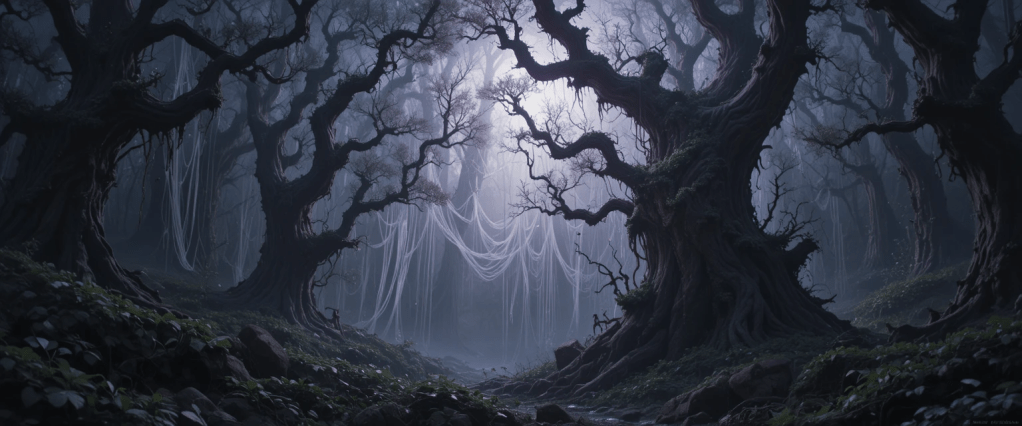
The forest thinned as the light faded, not into darkness but into something worse—a dull, dust-choked twilight where sound felt absorbed before it could echo. That was when the webs began. At first they were just threads catching the corner of my vision, silver lines trembling between trees. I brushed one away with my hand and felt resistance, far stronger than silk should allow. It did not break. It flexed, alive.
I should have left then.
Instead, I followed the pattern.
The webbing grew denser the farther I went, layered upon itself like abandoned architecture. Whole clearings were roofed over, light filtering through in fractured shapes. Leaves hung suspended mid-fall, caught months—maybe years—ago. Even bones were there: birds, small animals, things I refused to identify. They were not wrapped tightly, not drained or gnawed. Just… kept. Preserved, as if waiting.
That was when I understood this was not a hunter’s trap.
It was a library.
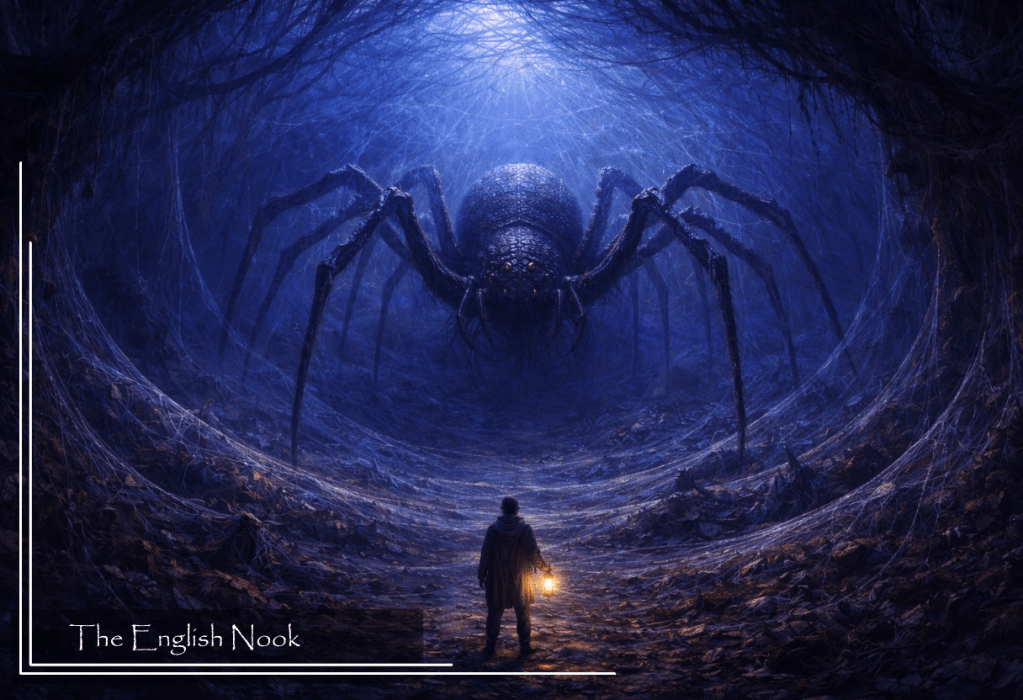
I felt it before I saw it: a pressure behind the eyes, a sensation like being read. The ground dipped, and the trees parted into a vast hollow where the web converged into a single structure—a cathedral spun rather than built. And at its center sat the Great Weaver.
Calling it a spider feels dishonest, but no better word exists. Its body was immense, larger than a house, yet proportioned with an almost mathematical elegance. Each leg rested delicately against strands thicker than ship’s rope, and its abdomen pulsed slowly, threads extruding and retracting like breath. The surface of it was not monstrous in the way stories promise—no dripping fangs, no theatrical menace—but textured, scarred, real. Ancient.
It did not move when I stepped forward.
“You can see me,” it said.
The voice did not come from its mouth. It came from the web. From the air. From inside my chest.
I tried to speak and failed. My fear wasn’t sharp—it was heavy, settling into me like wet soil.
“Few do,” the Weaver continued. “Fewer still arrive intact.”
I asked it the first question that came to me, which was also the most useless.
“What are you?”
The Weaver shifted then, just slightly. The web sang—a low vibration that rattled my teeth.
“I am what remains,” it said. “I bind what would otherwise be lost.”
It showed me then—not with images, but with sensation. Threads connected to moments: a hunter’s last regret, a child’s unspoken apology, a village forgotten by maps and memory alike. The web did not trap bodies alone. It caught events. Stories. Endings that never quite finished.
“You eat them?” I asked, my voice finally returning.
“No,” it replied, and I felt something like amusement. “I prevent their disappearance.”
The truth settled slowly, painfully. The forest was not abandoned. It was full—overfull—with the discarded weight of the world. When things fell through the cracks of history, when no one remembered enough to carry them forward, they ended up here. Held together by silk and patience.
“And me?” I asked. “Why am I here?”
The Great Weaver turned one eye toward me. In it, I saw my own reflection stretched thin, threaded through choices I had never examined.
“You noticed the pattern,” it said. “And you stayed.”
A strand brushed my ankle—not binding, just touching. I felt years of my life hum along it: moments I had abandoned, words I never finished saying, versions of myself left behind without burial.
“You may leave,” the Weaver said. “Or you may remain.”
I knew what remaining meant. Not death. Not exactly. To be woven was to be kept—to become part of the structure that holds the world together when memory fails. To be meaningful, but never free.
I stepped back.
The web did not resist.
As I walked away, the forest slowly loosened its grip. Light returned. Sound returned. The last thing I heard before the silence broke was the Weaver’s voice, softer now.
“Everything is held by something,” it said. “Most simply do not see the threads.”
I still feel them, sometimes. When I hesitate. When a memory refuses to fade. When patterns emerge where randomness should be.
I did leave.
But I am not sure the Great Weaver ever let go.
You can leave the web—but the web may never leave you.
Note:
Thank you for reading “The Great Weaver”! This is a story in a series created for avid readers and English learners who want to enjoy captivating tales while practicing their language skills. Stay tuned for more stories and language tips to enhance your journey!
Explore more short stories in English and Spanish by visiting the section:
Short Stories / Cuentos Cortos
When the world feels dull, your mind restless, or your heart heavy, let a story be your escape. Just one page, one sentence, one word—and suddenly, you’re somewhere new, where imagination breathes life into the ordinary and turns the simplest moments into magic.
“Liked it? Smash that like button! 💥❤️”

 The English Nook
Leave a comment