

Cómo ordenar ideas, acciones y procesos paso a paso
When we explain a process, tell a story, or give instructions, we need sequence markers—words that show order, progression, and logical flow.
English relies heavily on first, then, after that, finally. Spanish has direct equivalents, but also some important differences in use, register, and flexibility.
This guide is designed for English speakers learning Spanish, with clear explanations, practical examples, and common patterns you’ll actually hear and use.
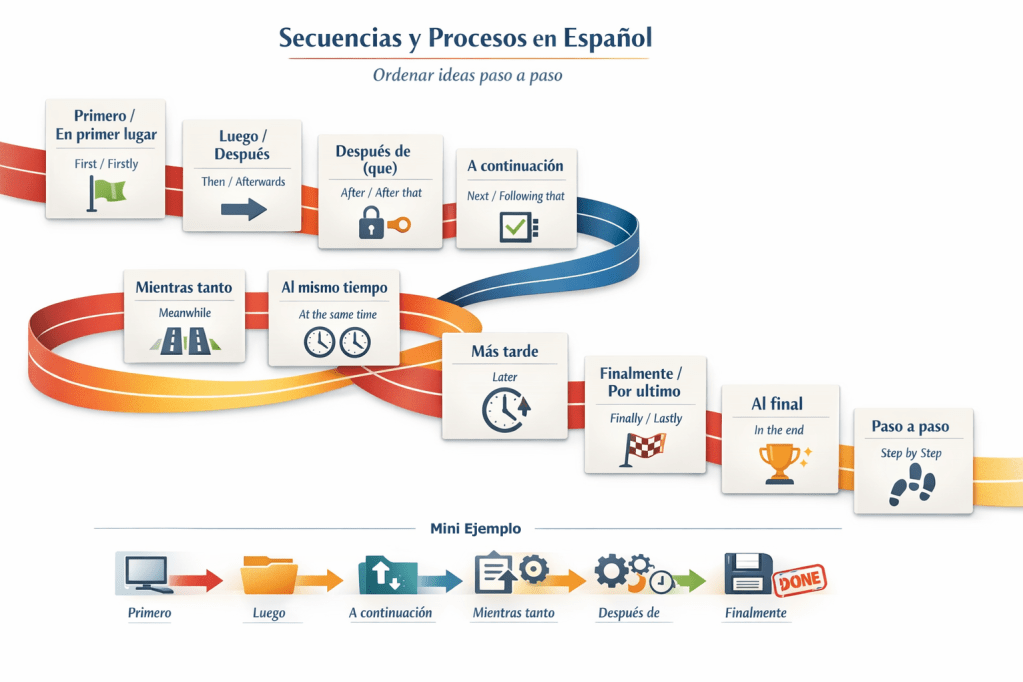
1. Primero / En primer lugar
First / Firstly
Used to introduce the first step or point in a sequence.
- Primero, abre el archivo.
- En primer lugar, debemos entender el problema.
📝 Note:
- Primero is more natural and conversational.
- En primer lugar is slightly more formal, often used in writing or presentations.
2. Luego / Después
Then / Afterwards
These are your go-to words for the next step.
- Luego, añade los ingredientes.
- Después, salimos a caminar.
📝 Difference:
- Luego = closer to then
- Después = closer to afterwards (can imply a bit more distance in time)
3. Después de (que)
After (that / doing something)
Used when one action depends on another.
- Después de comer, estudié.
- Después de que terminó la reunión, hablamos.
📝 Grammar tip:
- Después de + infinitive → same subject
- Después de que + verb → different subject (subjunctive often required)
4. A continuación
Next / Following that
Very common in instructions, manuals, recipes, and formal explanations.
- A continuación, presione el botón verde.
- A continuación, se presentan los resultados.
📝 Feels more structured than luego.
5. Mientras tanto
Meanwhile / In the meantime
Used for parallel actions.
- El horno se calienta y, mientras tanto, preparamos la salsa.
- Ella trabajaba y, mientras tanto, yo estudiaba.
📝 Excellent for showing simultaneity.
6. Al mismo tiempo
At the same time
Stronger emphasis on exact simultaneity.
- Hablaba y escribía al mismo tiempo.
- Ambos reaccionaron al mismo tiempo.
7. Más tarde
Later
Used when the next action happens clearly later, not immediately.
- Más tarde, volvimos a casa.
- Lo hablaré más tarde.
📝 Neutral and very common in everyday Spanish.
8. Finalmente / Por último
Finally / Lastly
Marks the end of a sequence.
- Finalmente, cerramos el proyecto.
- Por último, agradezco su atención.
📝
- Finalmente → neutral, very common
- Por último → slightly more formal or rhetorical
9. Al final
In the end / At the end
Focuses more on the result or outcome, not just the order.
- Al final, todo salió bien.
- Al final del proceso, obtenemos el producto final.
📝 Often emotional or reflective.
10. Paso a paso
Step by step
Used to emphasize methodical progression.
- Te lo explicaré paso a paso.
- El sistema funciona paso a paso.
📝 Very useful in teaching, tutorials, and explanations.
Mini Example: A Full Process in Spanish
Primero, encendemos la computadora.
Luego, abrimos el programa.
A continuación, cargamos el archivo.
Mientras tanto, el sistema se actualiza.
Después de revisar los datos, hacemos los cambios.
Finalmente, guardamos el documento.
Conclusion
Sequencing language in Spanish is rich, flexible, and highly contextual. While many expressions map neatly onto English equivalents, Spanish often allows more variation in word order and tone, especially in spoken language.
Mastering these connectors will help you:
- Explain processes clearly
- Tell better stories
- Sound more natural and organized in Spanish
Once these markers become automatic, your Spanish will feel structured, fluent, and confident—not just correct.
Order your words well, and your Spanish will follow.
If you’ve read everything, please consider leaving a like, sharing, commenting, or all three!
Need some help with your Spanish journey? Go to the contact area and send me a message; I’ll get back to you as soon as possible!
YOU WILL ALSO LIKE:






 The English Nook
Leave a comment