

Rooms That Do Not Answer
When the elevator stopped, Haru felt a strange relief, as if the building itself had finally acknowledged him.
The notice taped to the door said Under Maintenance in neat, polite characters. He read it twice, not because he needed to, but because he had no other reason to stand there. Behind him, someone cleared their throat, impatient. Haru stepped aside, bowed slightly, and began climbing the stairs.
The stairwell smelled of iron and old water. The fluorescent lights flickered with the slow pulse of something alive but tired of being alive.
He realized he had not taken the stairs in years.
On the first floor, a man he had seen many times was watering plastic plants. The man nodded, as if confirming that Haru still existed. On the third floor, a child’s drawing of a cat had been taped to the wall, the corners curling inward like fingernails. On the sixth floor, the air was colder.
By the ninth floor, his legs ached, but the pain felt unreal, distant—like it belonged to someone else who shared his body.
Inside his apartment, silence waited for him like a loyal pet.
He removed his shoes and sat on the tatami. The room was arranged with deliberate simplicity: one table, one bookshelf, one futon. He had chosen minimalism years ago, believing that fewer objects meant fewer attachments. Now the room looked less like a lifestyle choice and more like evidence.
He poured water into the kettle and turned on the stove. The flame flickered, a small fragile existence he could extinguish with one careless breath. He wondered how many flames had disappeared unnoticed while he was alive.
He sat and watched the river through the window. The water moved, but nothing seemed to change.
He tried to remember the last time he had touched another person. A handshake at work? A cashier handing him change? The memory felt theoretical, like recalling a fact from a textbook.
The kettle screamed. He turned it off too late, letting the sound linger longer than necessary, as if it could fill the room with something resembling presence.
At night, he dreamed of rooms.
In the dream, he walked through a hallway that never curved, never ended. Each door had his name written on it in slightly different handwriting. He opened one door and found a childhood classroom, empty except for his desk. Another door opened to his parents’ living room, but the furniture was gone, leaving only rectangular marks on the floor where things had once mattered.
Behind the final door, he found himself sitting at a table, writing nothing in a notebook that already contained nothing.
He tried to ask the version of himself across the table why he was writing, but the other Haru did not respond. Instead, he kept writing blank pages with intense concentration, as if the emptiness itself were a message that had to be recorded precisely.
He woke up before understanding.
The elevator was repaired the next morning. The doors opened with a soft mechanical sigh, like a tired person conceding to continue living.
Haru stood in front of it for a long time.
He thought about the stairs: the piano on the second floor, the laughter on the fourth, the heavy silence on the seventh. Each floor was a small universe he passed through but never entered. He realized his life was the same: a vertical corridor of floors, each moment passed through but never inhabited.
He stepped inside the elevator.
The mirror reflected him with a delay that might have been imagined. His face looked younger than he felt, older than he remembered. The reflection watched him with mild curiosity, like a stranger who had read his file but not his thoughts.
As the elevator descended, he felt weightless, as if gravity had momentarily forgotten him. He imagined the cable snapping. He imagined the sensation of falling, the brief absolute clarity before impact.
He wondered whether that clarity would feel like meaning.
The elevator stopped at the ground floor. The doors opened.
He did not move.
Someone behind him asked politely if he was getting out. Haru stepped aside, bowed, and let the person pass. He stayed inside, letting the doors close again. The elevator rose.
Up and down, up and down.
He pressed no buttons. He watched numbers change, watched doors open and close, watched people enter and exit, carrying groceries, umbrellas, tired expressions. Each person left with their own gravity, their own narrative.
He remained.
At some point, a child asked his mother why the man was still there. The mother whispered that some people just like elevators.
Haru found that explanation comforting.
The elevator became a small moving room that asked nothing of him. No conversations, no memories, no future plans. Only vertical motion, endlessly reversible.
He imagined spending the rest of his life riding it.
When he finally stepped out on the ninth floor, the hallway felt unfamiliar, as if he had already moved out years ago and was only visiting. His apartment key turned with a dull click that sounded final.
Inside, the room greeted him with its faithful emptiness.
He sat on the floor. He did not turn on the kettle.
The river outside continued to move, carrying light, carrying time, carrying nothing he could name.
He wondered if existence was simply the act of being carried by something you did not understand, toward somewhere you would never recognize.
For a moment, he imagined erasing his name from every door in the dream hallway. No doors, no rooms, no stairs, no elevators—just a corridor without markers.
The thought felt peaceful.
He lay down on the futon and stared at the ceiling. The light fixture flickered faintly, struggling against the dark.
He did not fall asleep. He did not think.
He simply remained, like an object that had forgotten why it had been placed in the world.
Outside, the elevator moved.
Inside, Haru did not.
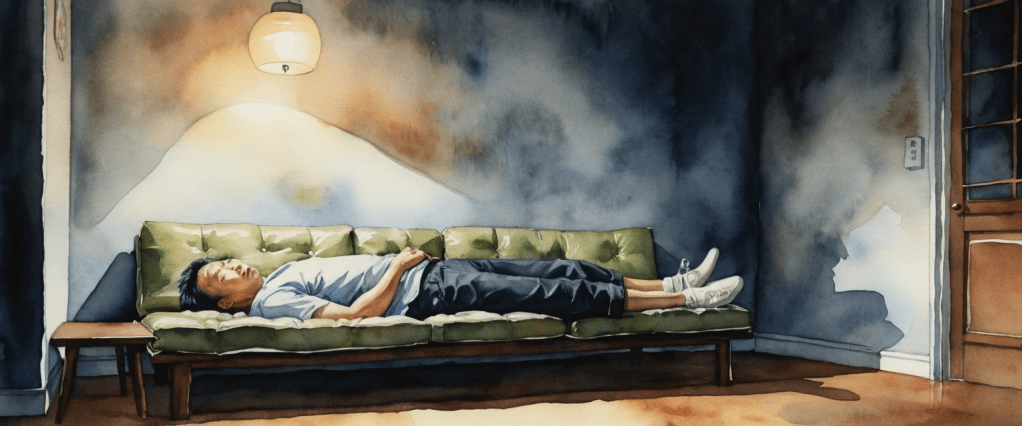
Some spaces move endlessly while the self stays still.
Note:
Thank you for reading “Rooms That Do Not Answer”! This is a story in a series created for avid readers and English learners who want to enjoy captivating tales while practicing their language skills. Stay tuned for more stories and language tips to enhance your journey!
Explore more short stories in English and Spanish by visiting the section:
Short Stories / Cuentos Cortos
When the world feels dull, your mind restless, or your heart heavy, let a story be your escape. Just one page, one sentence, one word—and suddenly, you’re somewhere new, where imagination breathes life into the ordinary and turns the simplest moments into magic.
“Liked it? Smash that like button! 💥❤️”


 The English Nook
Leave a comment