
The Ash Man of Blackpine Wood
Long ago, on the edge of Blackpine Wood, there stood a village that did not sing.
The bells in its chapel were cracked, the windows were shuttered even at noon, and the people spoke in whispers, as though the forest itself were listening. Snow fell there not like a blessing, but like ash—thin, grey, and relentless.
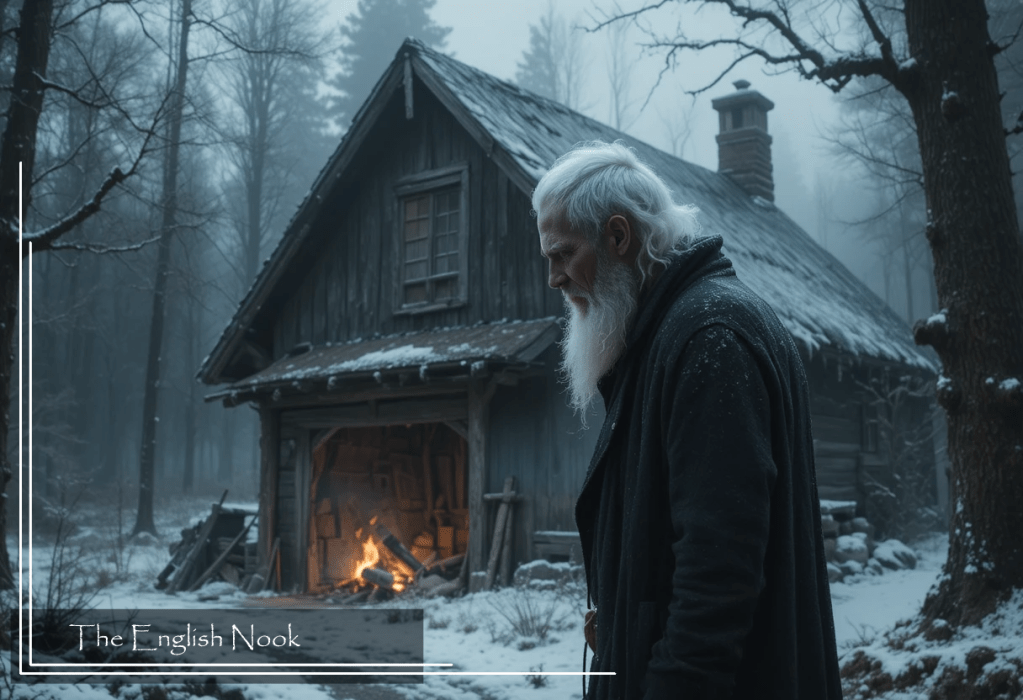
In that village lived a man known only as the Ash Man.
No one remembered his real name. Children said he had burned it long ago, along with his heart. He lived in a crooked house near the trees, where the smoke from his chimney was always dark, even in winter. He sold firewood, but never smiled. He took coins, but never thanked. If a beggar knocked at his door, the door stayed closed. If a child cried in the street, he walked faster.
“Beware him,” the elders said.
“He feeds the fire, not the light,” whispered the mothers.
And so the village feared him—and perhaps, in secret, hated him.
On the longest night of the year, when the snow lay thick as a burial cloth and the moon was thin and sharp, the Ash Man returned from the forest dragging a sled heavy with wood. His breath smoked like a dying flame.
As he reached his door, he heard a sound.
Not the wind.
Not the creak of trees.
A knock.
He froze.
No one knocked at his door.
Another knock followed—slow, deliberate.
With a scowl, he wrenched the door open. Before him stood a child, thin as a shadow, wrapped in rags far too light for the cold. Her eyes were bright, painfully so.
“Sir,” she said softly, “may I warm myself by your fire?”
The Ash Man laughed—a dry, broken sound.
“Fire is paid for,” he said. “Warmth is earned.”
The child looked past him, into the dark house.
“But you have so much,” she whispered.
His face hardened. “And I have lost more.”
He slammed the door.
The wind screamed. The knock did not return.
That night, the fire in his hearth burned strangely low. The logs hissed and cracked, though they were dry. Shadows stretched too long along the walls, twisting into shapes that looked almost like memories.
Then the dreams came.
He saw himself as a boy, barefoot in snow, holding a lantern that flickered weakly. He saw a home once warm, once full of laughter, swallowed by fire—not kind fire, but greedy fire. He woke choking on smoke that was not there.
At midnight, the room grew colder still.
A figure rose from the ashes of the hearth—tall, pale, crowned with frost.
“I am the Spirit of What Was Lost,” it said, its voice like wind through dead branches.
The Ash Man tried to scream, but no sound came.
The spirit showed him the night his village burned years ago: how others had begged him for help, how he had guarded his wood, his fire, his warmth—while everything else was taken. It showed him how fear hardened into bitterness, and bitterness into cruelty.
Then the spirit was gone.
Another came—wrapped in chains of ice, its eyes glowing blue.
“I am the Spirit of What Is,” it said.
It showed the village now: cold homes, empty tables, children learning silence too young. It showed how people feared him—but more than that, how they had once hoped he might change, and how that hope had slowly frozen.
Finally, as dawn neared, the last spirit appeared.
It was small. Bright. Wrapped in green and gold.
“I am the Spirit of What May Yet Be,” it said gently.
It showed no graves.
Only doors opening.
Only hands passing warmth from one to another.
Only fire shared—and light returning.
The Ash Man woke with a cry.
The fire was almost dead.
Outside, bells rang again—imperfect, but clear—the first living sound they had made in years.
It was Christmas morning.
For the first time in longer than he could remember, the Ash Man wept. The tears burned his face, long delayed, heavy with every word he had never spoken and every kindness he had refused. With each breath, something tight and buried loosened in his chest.
He threw on his coat and ran into the snow, careless of the cold, careless of the eyes watching from behind shutters. He split his wood until his hands blistered and bled, but he did not stop. Each log that broke beneath the axe felt like a door opening inside him. He stacked the wood high and dragged it through the village, carving new lines into streets long left untouched.
He went from house to house.
At the first door, people stared in disbelief. At the second, they hesitated, unsure whether to fear him. But when he knelt to build their fires, when flames caught and warmth returned to rooms long accustomed to cold, fear gave way to wonder. Blankets were pressed into shaking hands. Bread was broken and shared. Soup steamed in bowls once empty. The village filled with sounds nearly forgotten—relief, laughter, quiet gratitude spoken through tears.
Children crept closer. Old men straightened their backs, as though warmth itself had reminded them who they once were. Mothers watched the firelight with hands to their mouths, daring to believe that this winter might not take everything.
When he reached the chapel, its doors groaned open, surprised to be used. The Ash Man placed his last log upon the hearth. The fire flared bright, sending gold up cracked walls and into corners where shadows had lived too long. He stood there, watching the flames dance, and smiled—truly smiled—for the first time, seeing fire not as something to hoard, but as something meant to be given.
Then a child approached him, shivering, her cheeks red with cold and wonder. Without a word, he knelt and wrapped his own coat around her shoulders, fastening it carefully, as though afraid the moment might vanish.
“You may warm yourself,” he said gently. “And stay.”
That night, the village sang. The sound rose into the cold sky—uncertain at first, then strong—until even the trees seemed to listen. Candles glowed in windows. Laughter spilled into the streets. The bells rang, cracked but joyful.
The snow fell white again, not like ash, but like grace.
And though Blackpine Wood remained dark, its edge glowed warmly—for fire, at last, had remembered how to give light.

Fire hoarded becomes ash—fire shared becomes light.
Note:
Thank you for reading “The Ash Man of Blackpine Wood”! This is a story in a series created for avid readers and English learners who want to enjoy captivating tales while practicing their language skills. Stay tuned for more stories and language tips to enhance your journey!
Explore more short stories in English and Spanish by visiting the section:
Short Stories / Cuentos Cortos
When the world feels dull, your mind restless, or your heart heavy, let a story be your escape. Just one page, one sentence, one word—and suddenly, you’re somewhere new, where imagination breathes life into the ordinary and turns the simplest moments into magic.
“Liked it? Smash that like button! 💥❤️”
 The English Nook
Leave a comment