The Leviathan of Hollow Coast
The fishermen of the northern shores used to whisper that the sea itself had a shadow—a shape older than the tides, older than the moon’s pull, older even than the memory of the deep. They called it The Leviathan of Hollow Coast, though some only dared to say It. Not out of reverence, but out of resignation. The creature did not need a name to be real.
The Origins of the Shadow
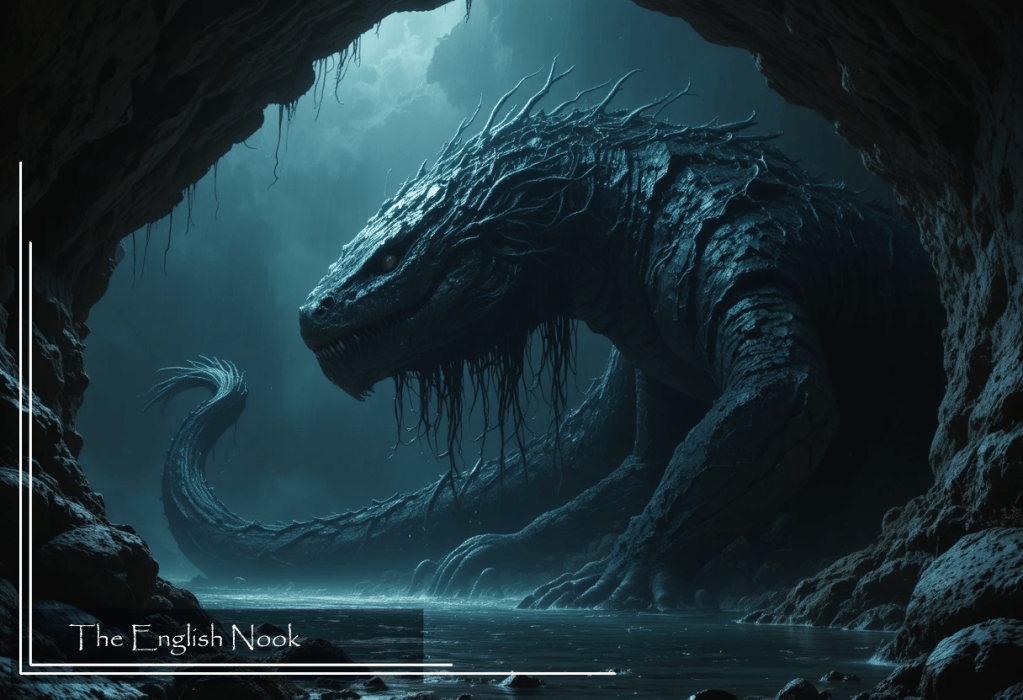
Long before any settlement, before the wooden docks and the shanty taverns and the children who played with tin boats in the surf, the ancient sailors spoke of a presence in the underwater caves carved into the cliffside. Hollow and labyrinthine, the caverns echoed with the deep rumble of unseen currents. Legends said the Leviathan slept in the furthest chamber, curled around black stone columns that had never seen the sun.
Some said it was a guardian. Others said a punishment. A few believed it was a remnant from the world’s creation, a creature left behind when the oceans cooled and life began to crawl ashore.
Whatever it was, the town that would later be called Hollow Coast existed only in its shadow.
And that shadow swallowed the town whole.
The Boy from the Next Valley
In the summer of 1926, Thomas Merrin was fourteen and restless. His own village, Redgate, lay just three miles inland, but it might as well have been three worlds away. No one in Redgate spoke of Hollow Coast anymore—not casually, not quietly, not even in drunken whispers.
Except the old ones. And Thomas Merrin always listened to the old ones.
He heard the stories in the smoke-filled corner of his grandfather’s workshop, where the man’s voice grew soft with memory. How the fishermen of Hollow Coast vanished one fog-shrouded morning. How the town’s windows cracked inward, as if struck by silent pressure from the sea. How only a single boat washed ashore, its wood wet but not from the tide—wet from something thicker, something that stained.
Thomas’s grandfather never finished the stories. He would always say:
“Things older than memory don’t like being remembered.”
That alone made Thomas want to know more.
The Journey to the Ghost Town
He left at dawn one day, telling his mother he was going to gather driftwood from the riverbank. Instead, he followed the old, overgrown coastal road. Vines strangled the fence posts. Rusted lantern hooks pointed like accusing fingers. The air grew heavier the closer he came to the sea, as if the horizon were pressing inward.
It took him two hours to reach the first rotted signpost:
HOLLOW COAST – 1 MILE
A cold wind moved through the trees, but they were still. Too still. The world around him felt muted, as though the birds had swallowed their own songs. Thomas Merrin walked faster.
When he finally saw the town, he felt his heartbeat thud—hard and hollow.
Hollow Coast stretched out along the cliffs like a memory no one wanted to claim. Roofs had collapsed inward. Doors hung open, swinging gently though no breeze touched them. Sand had buried streets in pale, uneven dunes. A schoolhouse bell dangled sideways, rust eating its edges.
Most eerie of all: there were no footprints.
Not human. Not animal.
Not even his own stayed long in the shifting sand—they softened unnaturally fast, as though the ground wanted to erase him.
But Thomas Merrin kept going, clutching his satchel tight. He knew what he had come for: the cave.
The Caves Beneath the Cliff
He found the entrance at low tide—just as his grandfather once described. A jagged crack in the cliff face, wide enough for a grown man to stoop through. The air that seeped from it was colder than the sea wind. Salt and something metallic clung to it.
The darkness swallowed him immediately.
Thomas Merrin lit his oil lantern and descended, foot by cautious foot, into the cavern. The walls were wet with condensation, streaked with black algae that pulsed faintly in the lantern’s glow. The sound of dripping water echoed in long, irregular intervals—too slow for normal cave drips, too resonant, as though each drop fell from a great height.
The tunnel twisted downward, sometimes narrow enough that Thomas Merrin’s shoulders scraped stone. But eventually it widened into an immense chamber.
A subterranean lake stretched before him—silent, black, unbroken. It was so still it looked like polished obsidian. Thomas approached the shore, his breath thin in his throat.
He whispered into the dark:
“Are you really here?”
The lake’s surface shivered.
Not from wind.
From something beneath.
The Leviathan Awakens
At first, Thomas Merrin thought he was imagining the movement. A ripple. A tremor. Then the black water bulged softly upward—not breaking the surface, just shifting, as though something massive rolled beneath it.
The lantern flickered.
Then he saw them.
Two glimmers—pale, distant, impossibly far apart—like moons rising through deep water. Eyes. Not glowing, but reflecting his lantern in a way that felt eerily intentional.
The lake swelled, and the creature ascended with silent grandeur.
The Leviathan rose without disturbing the water, as if the darkness parted to make room for it. Its skin was not scales but smooth, ancient stone—the texture of basalt cliffs polished by centuries of tides. Tendrils like kelp drifted from its jawline, drifting though no current moved them. Its size was beyond comprehension; Thomas Merrin saw only a fraction, and even that filled the chamber.
But its eyes—its enormous, glassy, abyssal eyes—fixed on him with a slow, sentient awareness.
Thomas tried to step back.
The ground vibrated, not with threat, but with recognition.
A sound reached him—a low, resonant hum that wasn’t quite a growl and wasn’t quite a song. It reverberated in his bones, in his teeth, in his memories. It felt like the sea remembering itself. Like storms forming. Like time unraveling.
He realized, suddenly, breathlessly:
The creature was old enough to remember everything.
And it had noticed him.
The Leviathan dipped its head slightly, the motion deliberate. A greeting. Or a warning. Or both.
Thomas Merrin whispered, unable to stop himself,
“What… are you?”
The creature’s hum deepened, rising and falling like a heartbeat. The lake pulsed with light—dim, bluish, slow—emanating from vast patterns etched across its body like runes of the deep.
He understood none of it, but he felt the meaning all the same:
I am the first dark.
The weight beneath memory.
The tide before tides.
And you are the first to look upon me unafraid.
The cavern trembled.
The water surged.
The Leviathan began to descend again, its stone-dark form slipping back into the lake without a sound. Before it vanished completely, one eye rose above the surface one last time—holding Thomas Merrin’s gaze with a depth that felt like centuries of unseen worlds.
And then it was gone.
The lake stilled.
The cavern fell silent.
The Boy Who Returned
Thomas Merrin emerged from the cave hours later, though the sun hadn’t moved. Time felt irrelevant now—thin, fragile, unimportant. He crossed through Hollow Coast without looking back. The town no longer frightened him; it seemed small now, like a faded photograph.
He knew what he had seen.
He knew what slept beneath the cliffs.
Some legends exist to warn.
Some exist to terrify.
And some exist simply because the world is older, stranger, and darker than people want to admit.
Thomas carried that knowledge home.
He told no one.
But sometimes, in the quietest moments, he thought he could still hear the Leviathan’s hum in the far-off tide—a reminder that something vast and ancient was dreaming just below the surface of the world.
And that it had opened one eye…
just for him.

When the sea remembers you, fear is only the beginning.
Note:
Thank you for reading “The Leviathan of Hollow Coast”! This is a story in a series created for avid readers and English learners who want to enjoy captivating tales while practicing their language skills. Stay tuned for more stories and language tips to enhance your journey!
Explore more short stories in English and Spanish by visiting the section:
Short Stories / Cuentos Cortos
When the world feels dull, your mind restless, or your heart heavy, let a story be your escape. Just one page, one sentence, one word—and suddenly, you’re somewhere new, where imagination breathes life into the ordinary and turns the simplest moments into magic.
“Liked it? Smash that like button! 💥❤️”



 The English Nook
Leave a comment