The House That Held Its Breath
No one visited the far edge of Marsh Lane anymore—not since the trees began growing inward, leaning like eavesdroppers, or since the wind developed the unsettling habit of going silent near the old house. It wasn’t fenced off, but it may as well have been. People crossed the street without thinking, conversations conveniently changed direction, and children dared each other to look at it only from a distance.
The house itself was enormous, yet strangely shrunken—its frame buckled as if exhausted. Shingles hung like loose scales. The porch sagged and creaked even when no one stood on it. Ivy crawled up the siding, thick and desperate, as though trying to smother the structure and erase whatever lived inside.
Daniel had heard the whispers all his life—strange lights, quiet footsteps, something moving behind boarded windows—but curiosity had always outweighed caution. He wasn’t a thrill-seeker or a believer in ghost stories. He just wanted to understand why a house could make grown adults cross the street without realizing it.
The front door didn’t resist when he pushed it open—it simply sighed.
Inside, the air felt stale but not abandoned—more like something had exhaled moments before he arrived. His flashlight swept across faded portraits whose subjects were too blurred to recognize, as if their features had been washed away by time or by something that preferred anonymity. Hallways stretched longer than they should have, ceilings sloped in strange angles, and every doorway seemed slightly too narrow, like the house had been built for shoulders thinner than human ones.
The silence wasn’t ordinary. It didn’t feel like the absence of sound—it felt like listening.
Daniel moved slowly, boots crunching over plaster and broken glass. He should’ve felt afraid, but another sensation took over—anticipation, almost welcome. As if the house had been waiting for footsteps like his.
He explored room after room: a collapsed dining hall, a bedroom overtaken by mold, a study whose books had rotted into pulp. The decay was total, unrestrained—except for one space.
At the very center of the house, Daniel found a room untouched by time.
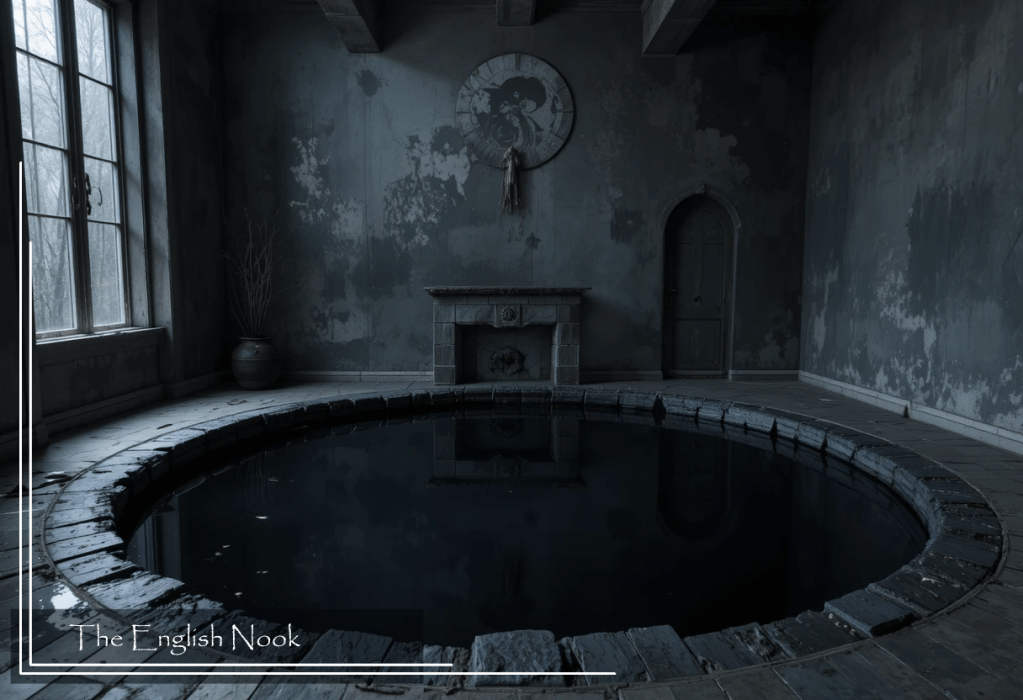
It was unnervingly clean—no dust, no debris, no fallen beams. The walls were bare, smooth, and pale. And there, consuming the floor, lay the pond.
Where Reflection Should Have Been
Daniel froze. The pond wasn’t large—maybe three meters across—but it felt vast. The water was impossibly dark, not muddy or murky, but pure black, like the surface was absorbing light rather than reflecting it. Even the flashlight beam vanished into it, swallowed without a glimmer.
A wrongness radiated from it—not threatening, just inexplicable. Why was there water inside a house? Why wasn’t the room humid? Why didn’t the water smell of algae or rot? Why did it feel… deliberate?
Daniel stepped closer, drawn despite himself. The air grew cooler, thick enough to taste—metallic, electric. His heartbeat slowed, steady and heavy, like time itself was pacing him. He leaned over the edge, half expecting to see his reflection.
He didn’t.
The water remained perfectly still, giving nothing back.
Then it moved.
The World Beneath Stillness
The surface didn’t ripple—it folded. It rose in a single swift motion, smooth and silent, like a shadow taking form. Before Daniel could step away, the pond surged upward and pulled him in—not violently, but with terrifying certainty, as though claiming something it had long been owed.
His breath didn’t burn. His lungs didn’t fill with water.
He floated.
Not in liquid—in light.
Colors streamed around him, vibrant and alive, bending and twisting like living thoughts. Currents of memory flowed beneath him. He heard music without instruments, voices without mouths, sentences made from emotions. He felt weightless, not just physically but existentially—unburdened, unanchored, unlimited.
Images moved across him—not seen, but understood: entire worlds built from imagination, forests dreamed into existence, skies textured with memory, creatures made of wonder rather than biology. Every thought became tangible, every feeling luminous. Magic wasn’t a force here—it was the environment.

Daniel didn’t question it—he belonged to it.
A warmth touched him, like being recognized rather than greeted. Something ancient and gentle guided him, not with words but with understanding. It wasn’t consuming him. It was showing him what existence could be without fear, without endings, without gravity.
For the first time in his life, Daniel felt whole.
And then—softly, almost apologetically—the pond let him go.
The House Kept Waiting
He emerged coughing air, landing on cold wooden floorboards. The room was silent again. His clothes dripped, but the water felt warm, almost comforting. The pond had returned to stillness—flat, dark, unreadable. No trace of motion, no evidence of what lay beneath. It looked exactly as it had before.
Had he imagined it?
No—he could still feel it inside him, glowing like a secret lantern.
Daniel stood slowly, staring at the motionless surface. The house was no longer frightening—but neither was it comforting. The silence pressed against him. The darkness felt heavier now, not threatening but… vacant. The stillness wasn’t peaceful—it was hollow.
Something inside him flickered, then dimmed.
He blinked, expecting color, warmth, sound—anything resembling the world he had just left. But reality felt drained, thinner than paper, as if someone had wrung the life out of it. The air was stale, the walls dull, the floorboards cold. Even his own heartbeat sounded distant, uninterested.
He realized, with a sharp ache, that the light he had felt—brilliant and boundless—was gone. Not forgotten, not rejected… simply consumed by the world outside.
He stumbled back toward the entrance, not out of fear, but disorientation. The hallway looked the same, yet unbearably smaller, like a stage set pretending to be existence. He reached the front door and paused, waiting for something—warmth, clarity, meaning—yet nothing arrived.
He stepped outside anyway.
The sky was gray. The wind carried no scent. The world moved, but without wonder. Everything felt still and dark—not because of the house, but because of him. He had seen too much, felt too much, and now reality couldn’t keep up.
The door remained open behind him.
The house didn’t creak or breathe or acknowledge his leaving. It simply existed, unbothered—eternal, patient.
Inside, the pond rested in unbroken stillness.
As if the magic had never happened.
As if it could happen again.
As if it were waiting for the next person to learn how lifeless the world truly was without it.

Enter the house—lose the world.
Note:
Thank you for reading “The House That Held Its Breath”! This is a story in a series created for avid readers and English learners who want to enjoy captivating tales while practicing their language skills. Stay tuned for more stories and language tips to enhance your journey!
Explore more short stories in English and Spanish by visiting the section:
Short Stories / Cuentos Cortos
When the world feels dull, your mind restless, or your heart heavy, let a story be your escape. Just one page, one sentence, one word—and suddenly, you’re somewhere new, where imagination breathes life into the ordinary and turns the simplest moments into magic.
“Liked it? Smash that like button! 💥❤️”


 The English Nook
Leave a comment