
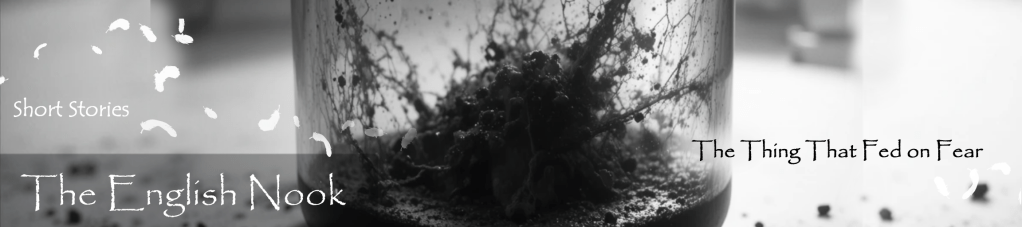
The Thing That Fed on Fear
It began as a smudge. A dark, shapeless patch no larger than a coin, clinging to the corner of the laboratory floor like a stain of spilled ink. Dr. Meredith Harlan noticed it one late evening while cataloguing samples. At first, she thought it was residue from the polymer experiments they’d been running that week—until it moved. A slow, deliberate twitch, as though it breathed.
She crouched, flashlight trembling in her hand, and watched as the thing pulsed—once, twice—then went still again. There was no sound, no heat signature, nothing on the instruments. When she scraped at it with a glass slide, the smear recoiled, leaving a faint vibration in the air, like the aftershock of sound you couldn’t quite hear. She sealed it in a containment jar and labeled it Specimen X-19.
By morning, the jar was half full of darkness.
At first, the team thought it was a trick of light, that their exhaustion had blurred the edges of reality. But as days passed, X-19 began to change—its surface shimmered like oil in water, and sometimes, when the lab was quiet, a faint whisper seemed to ripple through the room. None of them could make out words, only the low hum of something aware. They took turns observing it. No one wanted the night shift.
Then came the incident.
An intern, Louis, had stayed late to take readings. Hours later, security cameras caught him standing motionless before the containment case, trembling. His lips moved, as if answering someone unseen. When the morning crew arrived, he was gone. Only his ID badge remained, fused to the glass. Inside the jar, the darkness was larger—heavier—almost throbbing with quiet satisfaction.
They tested for chemical reactions, electromagnetic interference, anything. But the data made no sense. The mass didn’t consume matter or energy. Yet, it grew.
It was Meredith who understood first.
She’d begun having nightmares—visions of the lab drowned in shadow, whispers calling her name, her own reflection smiling when she did not. Her heartbeat would race when she neared the specimen, and the mass would quiver—as if pleased. That’s when she realized what it was feeding on.
Not oxygen. Not radiation. Not light.
Fear.
Every surge of terror, every gasp in the dark, every tremor in the human voice—it drank it all in. The more afraid they became, the stronger it grew. It learned to provoke that fear: flickering lights, cold drafts, reflections where none should be. The lab’s atmosphere thickened with it. No one laughed anymore. No one spoke above a whisper.
And with each heartbeat of dread, the thing swelled, until it no longer needed the jar.
When they finally sealed the building, it was too late. The surveillance footage showed only darkness spreading across the walls like liquid night, swallowing the light, the desks, the people. In the final frame, Dr. Meredith’s face flickered for a moment—eyes wide, mouth open—not in a scream, but in an expression of awe.
The lab stands empty now, locked behind concrete and steel. But sometimes, when the wind passes through the cracks of the foundation, there’s a sound—low, trembling, almost human.
It’s said that fear still lingers there. And the thing that fed on it… still hungers.

It didn’t feed on flesh — it fed on fear.
Note:
Thank you for reading “The Thing That Fed on Fear”! This is a story in a series created for avid readers and English learners who want to enjoy captivating tales while practicing their language skills. Stay tuned for more stories and language tips to enhance your journey!
Explore more short stories in English and Spanish by visiting the section:
Short Stories / Cuentos Cortos
When the world feels dull, your mind restless, or your heart heavy, let a story be your escape. Just one page, one sentence, one word—and suddenly, you’re somewhere new, where imagination breathes life into the ordinary and turns the simplest moments into magic.
“Liked it? Smash that like button! 💥❤️”


 The English Nook
Leave a comment