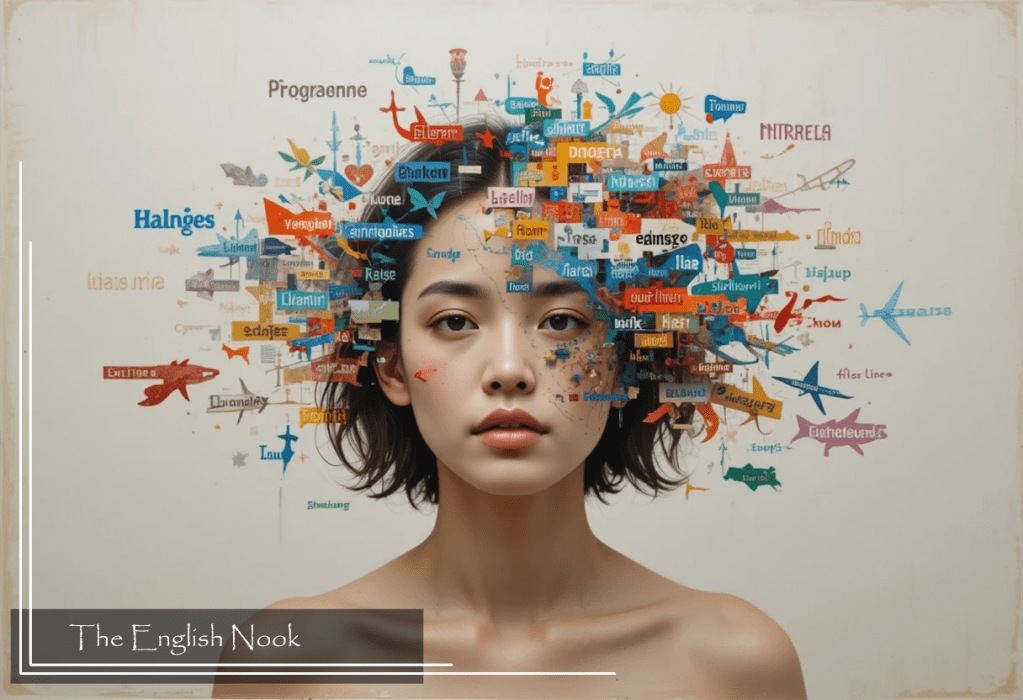

Personal Confidence and Identity:
The Empowerment of Expressing Yourself in Multiple Linguistic and Cultural Identities
In a world increasingly defined by borders that blur rather than divide, language has become more than a mere tool for communication—it is a mirror of identity. Each tongue we learn reshapes how we think, feel, and express ourselves. To be multilingual is to live several lives in one body, to see reality through more than one lens, and to discover that “self” is not a fixed entity, but an ever-expanding space where cultures, emotions, and ways of thinking coexist.
The Many Faces of the Self
When someone speaks a new language, something subtle yet profound happens. They don’t simply replace one set of words with another; they adjust tone, rhythm, posture—even personality. The French speaker may find themselves more nuanced and expressive with emotion; the Spanish speaker, more passionate and spontaneous; the English speaker, more direct and confident.
This transformation isn’t artificial—it’s a reflection of how deeply language shapes perception. Linguists and psychologists often speak of linguistic relativity, the idea that language influences the way we experience the world. A bilingual person doesn’t just switch codes; they shift perspectives.
Take, for instance, the case of someone who grew up speaking Korean but later mastered English. In Korean, humility and indirectness are embedded into speech patterns; in English, assertiveness and clarity are often valued. Moving between the two teaches that both humility and assertiveness have their place, and that one’s identity can flex to embrace each depending on context. Through this flexibility, multilingual individuals often become emotionally intelligent chameleons, capable of sensing and adapting to social subtleties across cultures.
Confidence Through Complexity
It is often said that confidence comes from competence, but in language learning, confidence is also born from vulnerability. To learn a new language is to make mistakes publicly, to laugh at one’s errors, and to persist despite discomfort. This process gradually builds not only linguistic skill but inner strength—a courage that extends far beyond grammar and pronunciation.
Every mispronounced word, every awkward pause becomes an act of resilience. Over time, learners discover that their worth isn’t diminished by imperfection; instead, it’s enhanced by effort. The result is a quiet confidence—a self-assurance rooted not in perfection, but in the ability to grow, adapt, and connect.
Moreover, this kind of confidence carries over into other areas of life. Those who speak multiple languages tend to approach challenges with curiosity rather than fear. They’ve learned that communication isn’t just about fluency—it’s about intent, empathy, and persistence. When you can navigate multiple linguistic realities, you begin to trust yourself more deeply, because you know that your voice can find its way in any space.
Belonging in More Than One World
Perhaps the most empowering aspect of multilingualism is its capacity to redefine belonging. Many bilinguals describe the feeling of being “at home” in several cultures, yet not completely confined to any. This can be both liberating and disorienting—a duality that shapes a more complex sense of identity.
Consider a person who speaks Spanish at home, English at work, and French with friends. Each language opens a distinct emotional register: warmth and familiarity in Spanish, professionalism and precision in English, playfulness and sophistication in French. Together, these linguistic selves weave a rich emotional tapestry that transcends national or cultural borders.
Rather than feeling fragmented, multilingual individuals often come to realize that their identities are layered. Each language adds another dimension to who they are—a different rhythm to their thoughts, a different melody to their emotions. This multiplicity nurtures empathy, because to speak another language is also to understand another way of being human.
The Power to Choose Your Voice
Perhaps the greatest empowerment multilingualism offers is the freedom of choice—the ability to decide which voice, tone, or worldview to inhabit at any given moment. It allows individuals to tailor how they express anger, affection, or humor. Some feelings might be easier to articulate in one language than another; some silences might carry different meanings depending on the culture.
For instance, saying I love you in English may feel bold and straightforward, while saying te quiero in Spanish carries a softer, more intimate tone. In Japanese, where direct emotional expression is often avoided, affection is shown through gesture and context rather than words. A multilingual person can navigate all these emotional landscapes, adjusting how they express care and vulnerability depending on the setting. That ability—to shape and reshape expression—creates a profound sense of autonomy and emotional intelligence.
The Freedom of the Multilingual Self
Ultimately, expressing yourself through multiple languages is an act of liberation. It’s the recognition that identity is not singular or static, but dynamic, evolving, and profoundly connected to how we communicate. Each new language gives us a new mirror, reflecting back another facet of who we are.
In this sense, multilingualism is not merely about mastering grammar or vocabulary—it’s about mastering the self. It teaches us that confidence isn’t about having one voice that never wavers, but about being able to find your voice in many forms.
To speak more than one language is to live more than one truth. It’s to know that who you are can expand endlessly, shaped by every word you learn, every culture you embrace, and every connection you make across the invisible bridges of language.
The more languages you speak, the more fully you become yourself.
If you’ve read everything, please consider leaving a like, sharing, commenting, or all three!
YOU WILL ALSO LIKE READING:






 The English Nook
Leave a comment