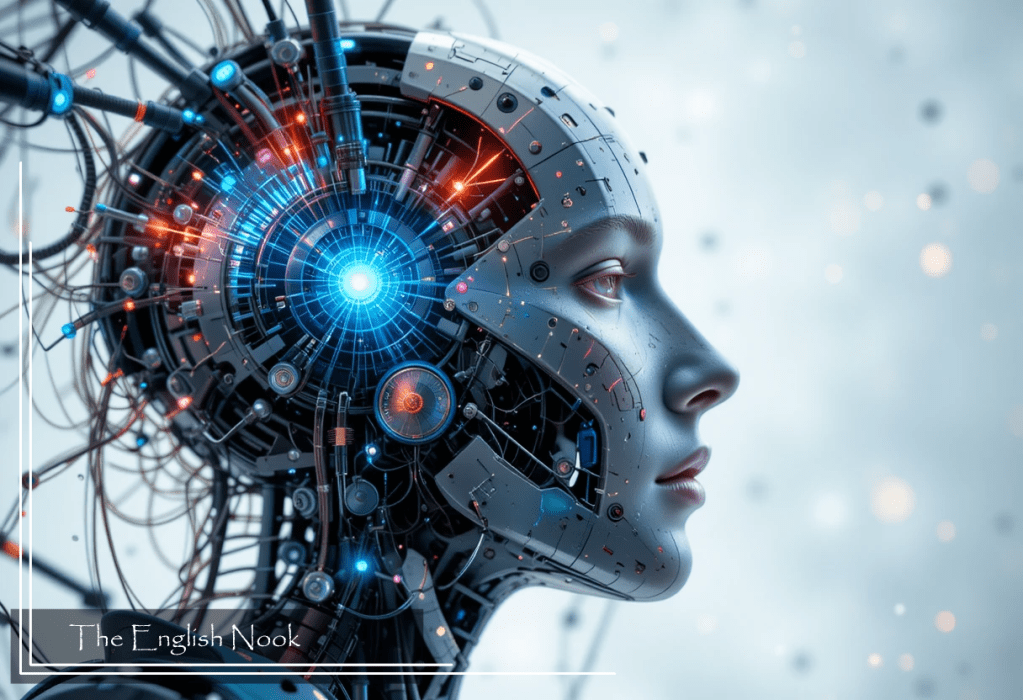

Revolution or Replacement?
In recent years, Artificial Intelligence (AI) has transformed nearly every field — and language learning is no exception. What once required textbooks, classrooms, and tutors can now happen through smart devices, voice assistants, and adaptive learning platforms. AI-powered tools like ChatGPT, Duolingo Max, and real-time speech generators are changing not just how we study languages, but what it means to learn them in the 21st century.
But as these tools become more sophisticated and widely used, one question grows louder:
Is AI enhancing the learning process — or quietly replacing it?
🌐 The Rise of AI in Language Learning
The integration of AI into language education has accelerated dramatically. Apps now analyze how we learn, predict our mistakes, and even adjust lessons to match our cognitive style. Duolingo, for instance, uses machine learning to tailor review sessions to the words learners are most likely to forget. Meanwhile, AI chatbots like ChatGPT can simulate conversations, explain grammar points, and offer context-rich examples on demand.
According to a 2024 survey by EdTech Research Group, more than 40% of language learners globally now use some form of AI assistance weekly. For independent learners, these tools offer unprecedented flexibility, interactivity, and personalization.
✅ Benefits: A Smarter Way to Learn?
AI offers several key advantages that are reshaping how people study languages:
1. Personalized Learning Paths
AI can assess your strengths and weaknesses in real time. Whether you struggle with prepositions or verb tenses, the system adapts and emphasizes your trouble spots automatically.
2. Immediate Feedback
You no longer need to wait for a teacher to mark your work. AI provides instant corrections, sometimes with clear explanations and usage examples.
3. Accessible Practice Anytime, Anywhere
Learners can engage with interactive content, simulations, or grammar reviews at their own pace and schedule — even at 3 a.m.
4. Reduced Anxiety for Beginners
Many students feel nervous speaking a new language with others. Practicing with an AI tutor offers a low-stakes environment to build confidence before interacting with real people.
5. Exposure to Multiple Registers
AI can switch between formal and informal language, provide synonyms, or mimic different tones and contexts — something that would otherwise take years of exposure to develop.
⚠️ The Risks and Limitations: What AI Can’t Do
While the benefits are impressive, AI in language learning is not without its flaws — and dangers. Some of these include:
1. Reinforcing Inaccuracies
AI-generated explanations may be incomplete or subtly incorrect, especially for complex grammar topics or idiomatic usage.
For example: An AI might accept “I have visited Paris last year,” overlooking the tense error — which could mislead beginners.
2. Lack of Human Nuance
Language is not just about structure and vocabulary — it’s about tone, culture, intention, and emotion. AI cannot read body language, interpret sarcasm, or understand social context the way humans can.
3. Reduced Motivation and Critical Thinking
If learners begin to outsource all their writing, translating, or summarizing to AI, their active use of the language may decline. Passive learning becomes tempting — and can weaken retention over time.
4. Ethical Concerns
In academic or testing environments, using AI to generate responses raises serious questions about plagiarism, authenticity, and the fairness of assessment. Some institutions are now developing tools to detect AI-generated texts.
🎓 What AI Still Can’t Replace (A Deep Analysis)
Despite its capabilities, AI cannot replace human connection. A real teacher or language partner brings:
- Empathy and encouragement
- Cultural knowledge
- Storytelling and humor
- Real emotional reactions
- Adaptability to the unexpected
Even advanced AI cannot feel confused, inspired, or surprised — key emotional states that shape human communication. These are essential for mastering not just the mechanics of a language, but the art of using it.
🔮 A Hybrid Future for Language Learning?
Most educators and researchers agree: The future of language learning lies in a hybrid model. AI should not replace human interaction — it should enhance it.
Think of AI not as a substitute, but as a powerful learning companion — helping you drill vocabulary, simulate conversations, and refine grammar between classes or conversations.
For example, a learner might use AI to:
- Practice small talk before traveling
- Get instant help with confusing articles in German
- Simulate a job interview or write emails in a business tone
But then they should apply what they’ve practiced with real people, in real time — where spontaneity, imperfection, and emotional intelligence come into play.
💬 Final Thoughts
AI is changing the way we learn languages — but it doesn’t change why we learn them: to connect, to understand, and to express ourselves. No algorithm can replace the experience of laughing at a language mistake with a friend, or understanding a joke in a foreign movie for the first time.
As AI continues to evolve, so must we — using its strengths, acknowledging its limits, and never forgetting that language is, above all, human.
📚 Discussion & Reflection Questions
- Which AI tools have you used (or heard of) for language learning? What did you think?
- Do you feel more comfortable speaking to a chatbot than a person? Why?
- In your opinion, should schools allow students to use AI for writing or translation tasks?
- What part of language learning do you think AI can never replace?
AI can teach you the rules—but only humans teach you the soul of a language.
If you’ve read everything, please consider leaving a like, sharing, commenting, or all three!
YOU WILL ALSO LIKE READING:







 The English Nook
Leave a comment