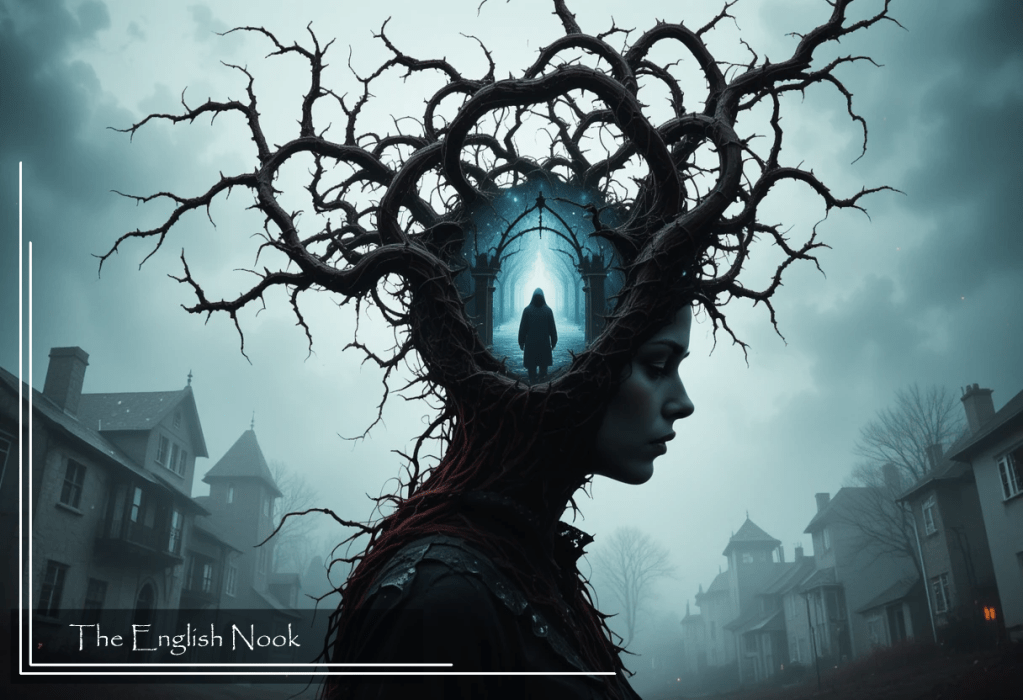

The Silent Festival
In a forgotten crease of the world, nestled between mist-draped hills and forested silence, lies the town of Nemea—a place untouched by time, unbothered by the outside world. No map marks its location, and no road leads directly to it. Travelers stumble upon it only by accident, and those who leave rarely speak of it again.
Life in Nemea is quiet. Not simply peaceful, but deliberately hushed. Words are used sparingly, exchanged only when necessary. It is said that speech can disturb the balance here, can stir things that are best left sleeping. For generations, the townsfolk have honored that unspoken pact: respect the quiet, and the quiet will protect you.
Once a year, during the night of the year’s last full moon, the town gathers to observe its most sacred and secret tradition: The Silent Festival.
It begins at dusk. The sun melts into the hills like candle wax, and the ever-present mist thickens until the world appears submerged. In the center of town stands the Circle of Memory, a wide stone ring said to predate the town itself, etched with indecipherable runes that pulse faintly only during the festival.
No one speaks. No one has ever spoken during the festival. To do so would be a breach—a dangerous one. Instead, thoughts are offered to the mist.
They do not know how or why this is possible. Only that it is. Thoughts become shapes—manifested projections—rising from the mind into the hovering mist above the circle. They shimmer, flicker, dance. Some take the form of vivid images—memories, dreams, symbols from the subconscious. Others appear as abstract lights, swirls of emotion rendered in color and rhythm.
It is beautiful. Sacred. And until now, safe.
This year, the mist felt different. Heavier. Hungrier.
At first, all was as it had always been. The townsfolk stood silently, their eyes closed, their faces serene. One by one, the first projections began to rise. A child’s laughter painted in soft yellow orbs. A young man’s memory of his lover beneath the old birch tree, fluttering in pale green ribbons. An old woman’s gratitude for her long life, a soft golden star.
Then came something… else.
It burst from the mind of Lira, the mayor’s only daughter—a jagged, blood-colored tangle, sharp and convulsing, like a thorned vine writhing in slow motion. It writhed above her head, then split, revealing within it the image of a hooded figure at a well—the same well where a child had gone missing many years ago.
The mist hissed.
The townspeople shifted, uneasy, but remained silent. Silence was the law. Silence was safety.
More shapes emerged. Distorted. Ominous. The blacksmith’s wife projected an image of her husband hammering late into the night—only he wasn’t forging metal. He was bending something that looked like a lock. A scream echoed silently from the mist, though no mouth uttered it.
Then, Dr. Miro, the town’s reclusive physician, stepped forward. His projection was a series of vials, each glowing with a sickly blue light. One shattered in mid-air, and the mist recoiled before reshaping itself into a woman’s face—lifeless, familiar. The townsfolk began to recognize her. She had been ill. She had died. Or so they thought.
The mist was no longer a gentle medium. It was revealing, exposing truths that had been hidden, even from the minds that bore them. It no longer obeyed intention. It reached deeper than memory. It drew from guilt. From fear. From the parts of the mind buried beneath denial.
A quiet panic spread. But still—no one dared speak.
The mist fed on the silence, growing denser, darker, until the lanterns could no longer pierce it. The runes on the Circle of Memory began to glow with a cold, pale light. And then, from the very center of the circle, a new projection rose.
It was unlike any that had come before.
A single orb, blue as midnight, hovered steadily in the air. Around it, silence grew absolute—not oppressive, but still. Calming. All eyes turned toward its source: an ancient woman seated cross-legged on the stone, her eyes closed, her hands resting in her lap. She was one of the Elders, though no one knew her name. She rarely appeared in daylight.
Her thought formed slowly, carefully. It became a tree—tall, bare of leaves, but glowing faintly from within. The tree’s roots extended downward into the mist, weaving through the dark projections like fingers. They touched the jagged, angry shapes—and the shapes softened. They didn’t vanish, but they quieted.
Then the tree branched out. Each limb reached toward a person—touching a child, a grieving widow, a trembling man. Wherever it touched, the mist changed hue, becoming translucent again. The tree was not erasing the darkness. It was accepting it. Holding it. Offering witness without judgment.
And then the tree split at its trunk, revealing its core: a mirror.
The mirror did not reflect the town, but something deeper. Within it, each person saw their own face—not as they appeared, but as they were, behind the masks they wore every day. Some wept. Some turned away. Some stepped closer.
The mist began to lift.
Dawn arrived, not with light, but with a hush. The festival was over. The projections faded. The silence remained—not the fearful hush of before, but a gentler quiet. A shared quiet.
No one spoke. No one needed to.
As they drifted away, the townsfolk carried something they hadn’t before: a quiet knowing. Of themselves. Of each other. Of what the mist could reveal—and forgive.
And in the center of the Circle of Memory, the ancient woman opened her eyes at last.
They were silver.
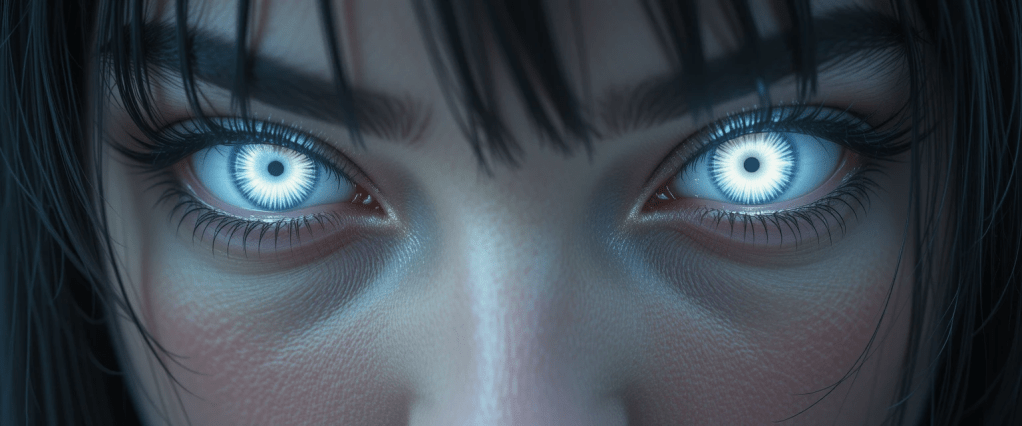
When silence speaks louder than truth, only the mist knows what we truly hide.
Note:
Thank you for reading “The Silent Festival”! This is a story in a series created for avid readers and English learners who want to enjoy captivating tales while practicing their language skills. Stay tuned for more stories and language tips to enhance your journey!
Explore more short stories in English and Spanish by visiting the section:
Short Stories / Cuentos Cortos
When the world feels dull, your mind restless, or your heart heavy, let a story be your escape. Just one page, one sentence, one word—and suddenly, you’re somewhere new, where imagination breathes life into the ordinary and turns the simplest moments into magic.
“Liked it? Smash that like button! 💥❤️”
 The English Nook
Leave a comment