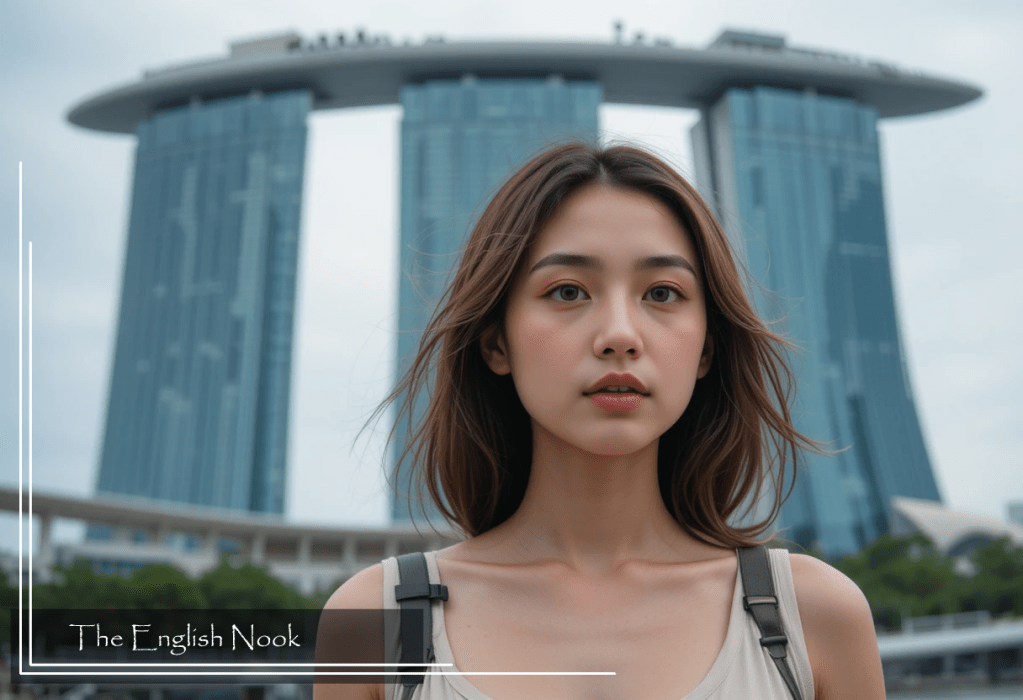

A Multilingual Symphony
Singaporean English, often known informally as Singlish, reflects the multicultural nature of Singapore. With influences from British English, Malay, Mandarin Chinese, Tamil, and various Chinese dialects (like Hokkien and Cantonese), Singlish is a lively, efficient, and highly expressive variety of English. While Singapore maintains Standard British English for formal communication (education, business, government), Singlish thrives in casual conversation and popular culture.
Vocabulary: Unique Local Expressions
Singlish is filled with words borrowed or adapted from different languages spoken in Singapore. Many expressions condense complex ideas into just a few syllables.
| British English | Singaporean English (Singlish) | Notes |
|---|---|---|
| very good | shiok /ʃiːɔk/ | Expression of great pleasure or satisfaction; from Malay |
| finished / over | habis /ha.biːs/ | From Malay, meaning “finished” or “gone” |
| a lot / many | so many lah! | “Lah” is a common particle for emphasis |
| embarrassed | paiseh /paɪˈseɪ/ | From Hokkien, meaning embarrassed or shy |
| very tired | sibei tired /siː.beɪ/ | “Sibei” from Hokkien, meaning “very” |
| annoying / irritating | kancheong /kan.tʃiː.ɔŋ/ | Nervous, anxious; from Cantonese |
Pronunciation: Simplified Sounds and Local Rhythm
Singlish pronunciation tends to be syllable-timed (each syllable gets about the same duration), unlike the stress-timed rhythm of British English. It also simplifies some consonant clusters.
| British English | Singaporean English (Singlish) | Notes |
|---|---|---|
| three /θriː/ | tree /triː/ | /θ/ becomes /t/ |
| think /θɪŋk/ | tink /tɪŋk/ | Same /θ/ to /t/ change |
| that /ðæt/ | dat /dæt/ | /ð/ becomes /d/ |
| months /mʌnθs/ | mons /mɒns/ | Cluster reduction: final “th” sound dropped |
| children /ˈtʃɪldrən/ | chirren /ˈtʃɪrən/ | Syllable simplification |
Grammar: Efficiency and Innovation
Singlish grammar simplifies certain structures and innovates with particles (small words added at the end of sentences to change the tone).
Key Features:
- Dropping subjects, objects, or auxiliaries when obvious:
- British English: “Are you going?”
- Singlish: “You going anot?” or just “Going anot?”
- Use of discourse particles for tone:
- lah: casual emphasis (“Come lah!”)
- lor: resignation or casualness (“Up to you lor.”)
- meh: doubt (“Really meh?”)
- leh: slight persuasion or emphasis (“Not bad leh!”)
- Simplified tense structures:
- British English: “I have already eaten.”
- Singlish: “I eat already.”
- Use of “can” for permission or ability:
- British English: “Is it possible?”
- Singlish: “Can or not?”
- Use of “then” to mark consequence:
- British English: “If you don’t study, you will fail.”
- Singlish: “You no study, then fail lor.”
Spelling: Standard vs. Informal Playfulness
Formal Singaporean English uses British spelling (colour, realise, centre), but informal Singlish in chats or social media often plays with spelling to reflect pronunciation.
| Formal | Informal Singlish |
|---|---|
| don’t | donch |
| with | wit |
| cannot | cannot / kenot / kenna |
| friend | fren |
| later | latah |
Cultural Context: Multicultural Identity
Singlish embodies Singapore’s identity: practical, direct, multicultural, and humorous. It often mixes words from several languages in the same sentence without hesitation, creating a truly blended linguistic landscape.
Example of a typical conversation:
British English:
A: “Hey, are you coming to lunch later?”
B: “Yes, I will come after my meeting.”
Singlish:
A: “Eh, you coming lunch anot?”
B: “Can, meeting finish then I come lor.”
Common Mistakes Learners Make
- Thinking Singlish is “incorrect English” rather than a creole-influenced, rule-governed variety.
- Overusing or misusing particles like lah and meh without understanding their emotional nuance.
- Not adapting tone—Singlish often sounds very casual and direct compared to British politeness norms.
- Assuming one Singlish phrase fits all—different settings (formal vs. informal) call for code-switching between Standard English and Singlish.
Visual Comparison Chart
| Feature | British English | Singaporean English (Singlish) |
|---|---|---|
| Vocabulary | very good, finished | shiok, habis |
| Pronunciation | three /θriː/, months /mʌnθs/ | tree /triː/, mons /mɒns/ |
| Grammar | I have eaten. | I eat already. |
| Spelling | colour, realise | colour, realise (formal) / kenot, fren (informal) |
Celebrating Linguistic Creativity
Singlish is not merely slang; it’s a creative, flexible, and expressive way of speaking. It reflects Singapore’s rich cultural tapestry and social realities. Embracing Singlish means appreciating how English evolves when cultures intertwine, creating a form of communication that’s uniquely Singaporean—warm, witty, and wonderfully efficient.
Singlish: where English meets Asia in a symphony of wit and warmth.
If you’ve read everything, please consider leaving a like, sharing, commenting, or all three!
YOU WILL ALSO LIKE READING:






 The English Nook
Leave a comment