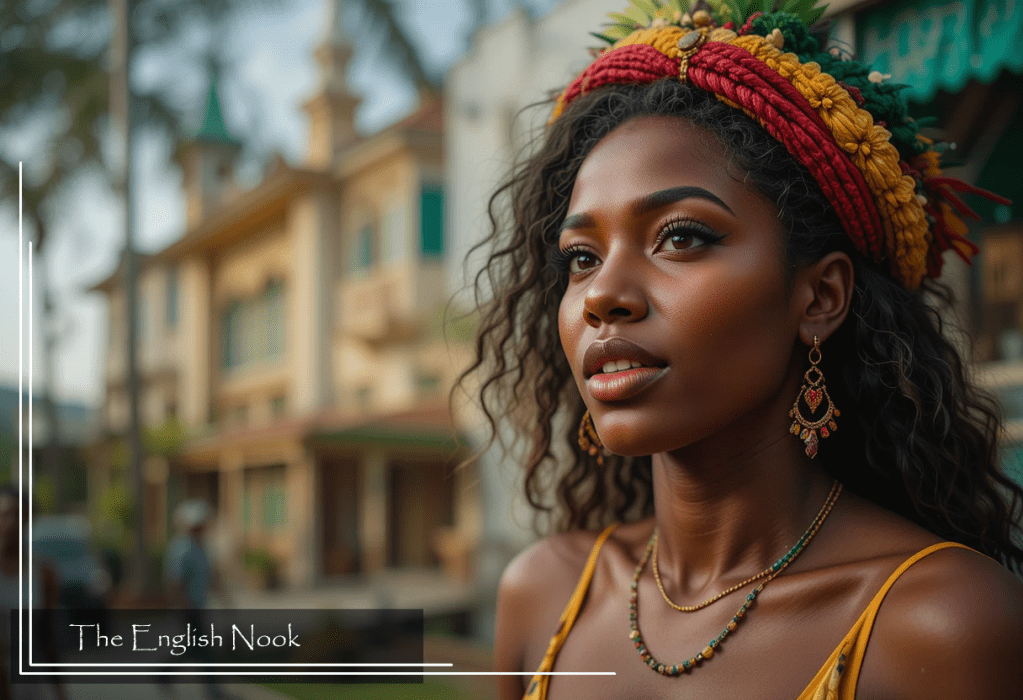

Voices from the Islands
Caribbean English is not a single dialect but a tapestry of English varieties spoken across the islands, including Jamaican English, Trinidadian English, Barbadian English, and others. Influenced by British colonization, African languages, indigenous tongues, and Creoles, Caribbean English is vibrant, musical, and culturally rich. While Standard British English serves as a base, the Caribbean adds its own rhythm, grammar, and lexicon.
Vocabulary: Words with Local Colour
Caribbean English features many expressions derived from local Creoles, African languages, and cultural references. These terms often carry meanings and connotations not found in British English.
| British English | Caribbean English | Notes |
|---|---|---|
| child | pickney /pikni/ | Common across many Caribbean countries, from West African roots |
| food | nyam /njæm/ | “To eat” in many Caribbean varieties, especially Jamaican English |
| friend | bredren /ˈbrɛdrən/ | A close friend, derived from “brethren” |
| tired | mash up /mæʃ ʌp/ | Can mean exhausted or broken |
| fight | buss a fight /bʌs ə faɪt/ | “Start a fight” – colloquial Jamaican English |
| dance | wine /waɪn/ | To gyrate or move hips rhythmically, especially in soca and dancehall contexts |
Pronunciation: Rhythmic and Creole-Influenced
While accents vary by island, Caribbean English often simplifies or changes consonants and vowels, with intonation and stress patterns strongly influenced by Creole rhythms and African prosody.
| British English | Caribbean English (Jamaican Example) | Notes |
|---|---|---|
| thing /θɪŋ/ | ting /tɪŋ/ | /θ/ becomes /t/ – a common change in Jamaican English |
| three /θriː/ | tree /triː/ | Again, /θ/ becomes /t/ |
| this /ðɪs/ | dis /dɪs/ | /ð/ becomes /d/ |
| ask /ɑːsk/ | aks /æks/ | Metathesis (switching of sounds), common across many dialects |
| mouth /maʊθ/ | mout /moʊt/ | Final /θ/ dropped or changed |
| don’t /dəʊnt/ | nuh do /nə du/ | Negation often marked by “nuh” or “nah” instead of “not” |
Grammar: Simplified Forms and Creole Influence
Many Caribbean varieties show grammatical features from local Creoles, such as the use of “does” for habitual aspect or dropping auxiliaries.
Examples:
| British English | Caribbean English | Notes |
|---|---|---|
| He doesn’t go there. | He nuh go deh. | Negation with “nuh” and no auxiliary |
| She’s always dancing. | She does always a wine. | “Does” for habitual aspect |
| They are going now. | Dem a go now. | “Dem” for “they” and “a” marks progressive aspect |
| I told him already. | Mi done tell him. | “Done” used for completed action |
| Are you coming? | Yuh a come? | “Yuh” for “you,” and “a” as a tense/aspect marker |
Spelling: Standard and Nonstandard Coexist
Official writing in Caribbean English (e.g., newspapers) often follows British spelling (e.g., colour, realise), but phonetic spelling appears in informal contexts, especially music, memes, and literature.
Examples:
| Standard (British) | Informal Caribbean English |
|---|---|
| don’t | nuh |
| with | wid |
| brother | bredren |
| out | outta / out |
Cultural Context: Music, Identity, and Expression
Language is central to Caribbean identity, especially through music genres like reggae, calypso, soca, and dancehall. Lyrics blend English, Creole, and local slang, giving insight into Caribbean worldviews, politics, and humour.
Reggae lyric (Jamaican English):
“Mi cyaan tek di pressure pon mi mind, mi need likkle peace.”
(I can’t take the pressure on my mind, I need a little peace.)
Everyday Conversation
British English:
A: “Do you want something to eat?”
B: “No thanks, I already ate.”
Caribbean English (e.g., Trinidadian):
A: “Yuh want someting to nyam?”
B: “Nah man, mi done nyam already.”
Common Mistakes Learners Make
- Assuming Caribbean English is “broken English” rather than a systematic dialect or Creole.
- Misinterpreting simplified grammar as uneducated speech.
- Failing to understand the deep cultural and musical context behind expressions.
- Not recognizing the register shift—Caribbean speakers often switch between Standard English and Creole depending on context.
Visual Comparison Chart
| Feature | British English | Caribbean English |
|---|---|---|
| Vocabulary | child, friend, eat | pickney, bredren, nyam |
| Pronunciation | thing /θɪŋ/, this /ðɪs/ | ting /tɪŋ/, dis /dɪs/ |
| Grammar | He doesn’t go. | Him nuh go. |
| Spelling | realise, colour | realise, colour (formal) / nuh, dem (informal) |
Celebrating Caribbean Voices
Caribbean English represents a fusion of histories, cultures, and languages. It’s expressive, musical, and steeped in resistance, survival, and creativity. Understanding it not only enriches one’s knowledge of English worldwide, but opens the door to the lived experiences and stories of Caribbean people. Whether you’re traveling to Kingston, Bridgetown, or Port of Spain—or just listening to a reggae track—Caribbean English invites you to feel the rhythm of its language.
Not broken—just brilliantly Caribbean.
If you’ve read everything, please consider leaving a like, sharing, commenting, or all three!
YOU WILL ALSO LIKE READING:






 The English Nook
Leave a comment