
🍀🍀🍀 St. Patrick’s Day 🍀🍀🍀
Every March 17, the world turns a shade greener to celebrate St. Patrick’s Day, a festivity that extends far beyond Ireland. While parades, shamrocks, and lively gatherings mark the occasion, the cultural and linguistic influence of this day on the English language is equally fascinating. From idioms to customs, St. Patrick’s Day has left an indelible mark on both language and global traditions.
The Origins of St. Patrick’s Day
St. Patrick’s Day traces its roots back to the 5th century, commemorating the death of St. Patrick, the patron saint of Ireland. Born in Roman Britain around the late 4th or early 5th century, Patrick was kidnapped by Irish raiders at the age of sixteen and taken to Ireland as a slave. He spent six years tending sheep, during which time he turned to prayer and faith. After experiencing a divine vision, he managed to escape and return to his family. However, feeling called to return to Ireland, he studied Christianity and became a missionary, eventually playing a key role in converting much of the Irish population to Christianity.
Patrick is credited with establishing churches, schools, and monasteries across Ireland, and his efforts solidified Christianity’s presence on the island. Legends surrounding him include banishing snakes from Ireland (though the island never had native snakes) and using the shamrock to illustrate the Holy Trinity. Over time, his influence was honored with a feast day, March 17, which was officially recognized by the Catholic Church in the 17th century. By the 18th and 19th centuries, Irish immigrants carried their traditions abroad, particularly to North America, where the holiday transformed into a grand celebration of Irish identity, marked by parades, festivals, and public gatherings.
🍀🍀🍀
Linguistic Contributions of St. Patrick’s Day
The legacy of St. Patrick’s Day is evident in the English lexicon, with numerous words and phrases stemming from Irish Gaelic and Irish traditions. One of the most recognizable symbols, the shamrock, derives from the Irish word seamróg, meaning “little clover.” This plant, which St. Patrick allegedly used to explain the concept of the Holy Trinity, has become synonymous with luck and Irish heritage.
Expressions such as “the luck of the Irish” and “drowning the shamrock” also have their roots in Irish culture. The former, often used to describe unexpected good fortune, has a historical irony, as Irish history is filled with hardship. The latter refers to the tradition of placing a shamrock in a drink before toasting on St. Patrick’s Day. Additionally, words like brogue (a strong Irish accent) and banshee (from bean sí, meaning “fairy woman”) have enriched the English language thanks to Irish mythology and folklore.
Beyond specific words, many expressions and idioms rooted in Irish culture have found their way into English. “Erin go Bragh,” meaning “Ireland forever,” is often heard during St. Patrick’s Day celebrations as a declaration of Irish pride. The phrase “top of the morning to you”, while stereotypically associated with Irish speech, originates from an old Irish greeting and is often responded to with “and the rest of the day to yourself.”
Irish storytelling has also influenced English idioms. For instance, the phrase “away with the fairies” is derived from Irish folklore, referring to someone who is daydreaming or lost in thought. Similarly, the term “blarney”, meaning persuasive flattery, comes from Blarney Castle in Ireland, where visitors kiss the Blarney Stone to gain the gift of eloquence.
Through these linguistic contributions, St. Patrick’s Day continues to be a significant cultural touchstone, demonstrating how Irish heritage has deeply intertwined with the English language.
🍀🍀🍀
Cultural Influence: A Global Celebration
Beyond language, St. Patrick’s Day has shaped global customs and traditions. Though originally a solemn religious feast, it has evolved into a worldwide celebration of Irish heritage. Cities such as New York, Boston, and Chicago hold massive parades, with the latter famously dyeing its river green. The phrase “wearing the green” originates from an old Irish tradition where people wore green ribbons and shamrocks to express national pride.
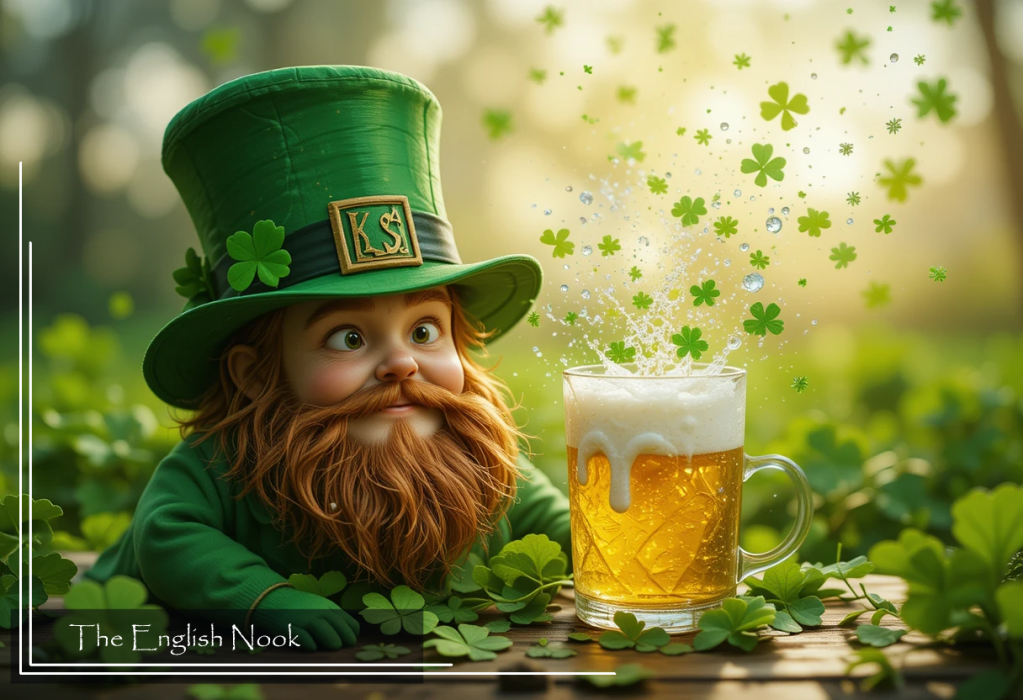
Another key tradition is raising a toast with a hearty “Sláinte!”—an Irish Gaelic word meaning “health.” The holiday also popularized the concept of the leprechaun, a mischievous fairy from Irish folklore, known for guarding pots of gold at the end of the rainbow.
The Everlasting Charm of St. Patrick’s Day
St. Patrick’s Day is more than just a celebration—it’s a testament to the enduring influence of Irish culture on the English language and global traditions. Whether through idioms, symbols, or customs, this day has woven itself into the fabric of everyday speech and festivities. So, on March 17, whether you’re enjoying a parade, wearing green, or simply saying “Sláinte!” with friends, remember that you’re partaking in a rich linguistic and cultural heritage that continues to thrive worldwide. 🍀
On March 17, wear the green and speak the luck—because St. Patrick’s Day isn’t just a celebration, it’s a language of its own!
🍀🍀🍀
Má tá gach rud léite agat, smaoinigh le do thoil ar thaitneamh a thabhairt, a roinnt, trácht a fhágáil, nó an triúr acu!
BAINFIDH TÚ TAITNEAMH AS LÉAMH FREISIN:







 The English Nook
Leave a comment