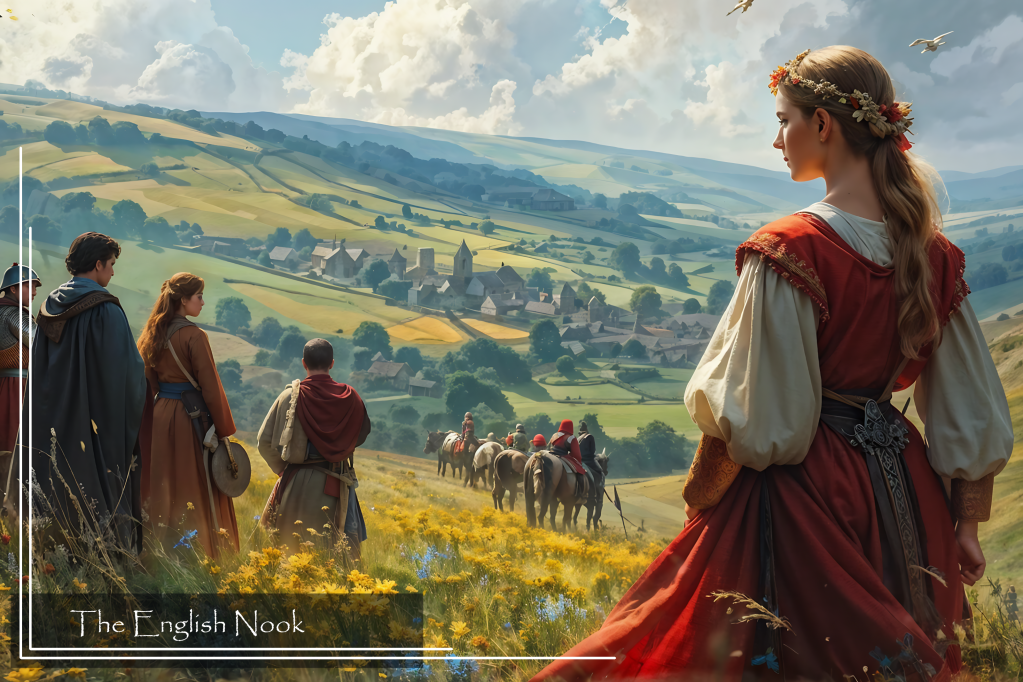

The Diverse Landscape of Old English Dialects
In early medieval England, the English language was not a single uniform tongue, but rather a collection of dialects spoken by various groups in different regions. These dialects mirrored the social and political fragmentation of the time and played a crucial role in the linguistic evolution of English. By examining the four primary dialects—Northumbrian, Mercian, West Saxon, and Kentish—we can gain valuable insights into the development of Old English and its enduring impact on the English language.
Key Dialects of Old English
Northumbrian: The Northern Accent of Old English
The Northumbrian dialect was spoken in northern England and parts of southern Scotland. One of the most famous texts written in this dialect is Cædmon’s Hymn, a religious poem that demonstrates distinct vowel shifts and other phonological features unique to Northumbrian.
- Example from Cædmon’s Hymn:
Old English:
“Nu sculon herigean heofonrices Weard,
Metodes mihte and his modgeþanc,
weorc Wuldorfæder, swa he wundra gehwæs,
ece Dryhten, ord onstealde.”
Modern English:
“Now we must praise the Guardian of heaven,
the might of the Creator and his thought,
the work of the Glory-Father, as he,
the eternal Lord, established the beginning of wonders.”
The vowel shift seen in herigean (to praise) is one example of the phonetic characteristics that set Northumbrian apart from other Old English dialects.
Mercian: Central England’s Influence
Mercian was the dialect of the central region of Anglo-Saxon England, including the kingdom of Mercia. Mercian texts were fewer in number, but it is believed that some legal documents and religious charters were written in this dialect.
- Example: The famous Peterborough Chronicle, part of the Anglo-Saxon Chronicle, contains entries written in late Old English with Mercian influence.
Like Northumbrian, Mercian shared features with other Germanic languages, but the Mercian dialect contributed many elements that would later appear in Middle English, especially in the Midlands.
West Saxon: The Dominant Literary Dialect
West Saxon became the dominant form of Old English, largely due to the political power of the West Saxon kingdom. Under King Alfred the Great, many important texts, including translations of Latin works and legal codes, were written in this dialect, making it the literary standard of the period.
- Example from Beowulf:
Old English:
“Hwæt! Wē Gār-Dena in geārdagum,
þēodcyninga, þrym gefrūnon,
hū ðā æþelingas ellen fremedon.”
Modern English:
“Lo, we have heard of the glory of the Spear-Danes,
the kings of the people, in the days of old,
how those princes performed courageous deeds.”
West Saxon’s prominence ensured that it was used for many literary and religious works, solidifying its place as the most recognized dialect of Old English.
Kentish: The Southeastern Dialect
Kentish was spoken in the southeastern part of England, in the kingdom of Kent. It had unique phonological features, some of which were influenced by Old Frisian, a Germanic language spoken by tribes who had settled nearby.
While not as well-documented as West Saxon, Kentish appears in various legal documents and charters. It is believed to have influenced later southern dialects of Middle English.
Phonological and Grammatical Features
Each of these dialects exhibited unique phonological characteristics, including differences in vowel sounds, verb conjugations, and word order. For example, in Northumbrian, the word for “king” was often written as cyning, whereas in West Saxon, it appeared as cyng. These variations, though subtle, help linguists trace the evolution of English sounds over time.
Table: Key Differences Between Old English Dialects
| Dialect | Region | Notable Texts | Key Linguistic Features |
|---|---|---|---|
| Northumbrian | Northern England, Scotland | Cædmon’s Hymn | Unique vowel shifts, nasal sounds |
| Mercian | Central England (Mercia) | Peterborough Chronicle | Influenced Middle English Midlands |
| West Saxon | Southern England | Beowulf, legal texts | Literary standard, vowel changes |
| Kentish | Southeastern England | Legal charters | Old Frisian influence, distinct phonology |
Historical Context: The Decline and Survival of Dialect
The Viking invasions of the 9th century devastated much of Northumbria, leading to the loss of many texts written in the Northumbrian dialect. As a result, West Saxon rose to prominence and became the dominant literary dialect, especially under King Alfred, who encouraged translations of important Latin works into Old English.
The political power of Wessex (West Saxon) allowed this dialect to dominate literary production, whereas other dialects, such as Mercian and Kentish, remained largely regional.
Transition to Middle English
The Norman Conquest of 1066 marked a significant turning point for the English language. The introduction of Norman French vocabulary and Latin administrative terms led to the gradual decline of Old English dialects. However, many Mercian elements, especially from the Midlands, survived and influenced the development of Middle English. Over time, these dialects merged, and Old English evolved into Middle English, setting the stage for the modern language.
The Legacy of Old English Dialects
The study of Old English dialects reveals not only the linguistic diversity of early medieval England but also the foundations of the English language we know today. Each dialect—whether Northumbrian, Mercian, West Saxon, or Kentish—offers a window into the cultural and political landscape of the time. While West Saxon became the literary standard, traces of other dialects can still be seen in later English developments. Through their unique phonological, grammatical, and syntactic features, these dialects collectively contributed to the rich linguistic heritage that has shaped the English language’s evolution over centuries.
From regional tongues to global language—Old English dialects paved the way for modern English!
If you’ve read everything, please consider leaving a like, sharing, commenting, or all three!
YOU WILL ALSO LIKE:





 The English Nook
Leave a comment