
A Comprehensive Overview
Old English, the earliest form of the English language spoken from around the 5th to the 11th centuries, had a rich and complex structure. It was highly inflected, meaning that word forms changed to express grammatical relationships. The rules governing Old English grammar and syntax differ significantly from those of modern English, making it a fascinating subject of study. Its system of cases, gender, and flexible word order provided a framework that allowed for nuanced expression, far more dependent on morphology than today’s English, which relies primarily on word order.
Grammar and Syntax in Old English
- Grammatical Cases
One of the most striking features of Old English was its use of four grammatical cases: the nominative, accusative, genitive, and dative. Each case served a distinct grammatical function:- Nominative case: Used for the subject of a sentence (who or what performs the action).
Example: se cyning (the king).
- Accusative case: Used for the direct object (who or what is affected by the action).
Example: þone cyning (the king, as a direct object).
- Genitive case: Used to express possession.
Example: þæs cyninges (of the king).
- Dative case: Used for the indirect object (to or for whom the action is done).
Example: þæm cyninge (to the king).
These cases allowed Old English speakers to vary word order without confusion, as the endings of the words indicated their roles in the sentence. - Nominative case: Used for the subject of a sentence (who or what performs the action).
- Gender
Old English nouns were categorized into three grammatical genders: masculine, feminine, and neuter. Unlike modern English, where gender is limited to biological distinctions (he/she/it), Old English applied gender to all nouns, regardless of their meaning. This affected how nouns were declined (modified) and how adjectives and articles agreed with them. For example, the word stan (stone) was masculine, giefu (gift) was feminine, and scip (ship) was neuter. - Verb Conjugation
Old English verbs were conjugated according to person, number, tense, mood, and voice, much like verbs in other highly inflected languages. This created a vast array of verb forms, making verb conjugation more complex than in modern English.
- Person: Verbs were conjugated in the first, second, and third person.
Example (present tense of drifan “to drive”):- 1st person singular: ic drife (I drive)
- 2nd person singular: þu drifest (you drive)
- 3rd person singular: he drifþ (he drives)
- Number: Verbs changed for singular and plural subjects.
Example (plural): we drifað (we drive). - Tense: Old English primarily distinguished between past and present tenses. The future was expressed through context or auxiliary verbs.
- Mood: Indicative (stating facts), subjunctive (expressing wishes or hypotheticals), and imperative (giving commands) moods existed.
Example (subjunctive): ic drife (I may drive). - Voice: Active and passive voices were used, though passive constructions were less common than in modern English.
- Person: Verbs were conjugated in the first, second, and third person.
- Word Order
Due to its inflectional system, Old English had a relatively flexible word order compared to modern English. While modern English relies heavily on a subject-verb-object (SVO) word order to clarify meaning, Old English allowed for variations such as subject-object-verb (SOV) or even verb-subject-object (VSO) because the case endings of words indicated their grammatical role. However, certain patterns were more common in specific contexts, such as placing the verb at the beginning in questions or in poetic forms.- Example (SVO): Se cyning geseah þone hund (The king saw the dog).
- Example (SOV): Se cyning þone hund geseah (The king the dog saw).
The flexibility of word order added a poetic quality to Old English, especially in literature, where authors could manipulate structure for stylistic effects without sacrificing clarity.
Old English Text:
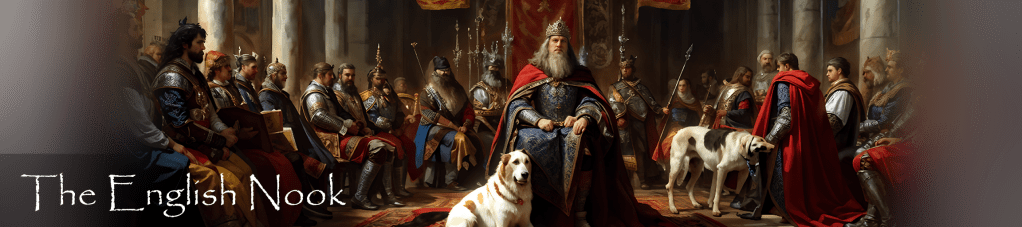
Se cyning wæs on þæm healle sittende mid his gesiþum. Þone hund, þe him lufode, eode to him and under his fotum hleol. Hwæt! Se cyning geseah þone hund and smylode, forþon he wæs getrywe þæm cyninge. Ealle þa menn on þæm healle wæron swiðe bliðe, forþæm þe se hund wæs leof mannum and se cyning wæs gód heora hlaford. Se cyning ongan to sprecan be his þegnum, þæt hi him ealle geþeowdon mid eornost. Þa cyningas of oðrum rícium eodon mid cyninge and heom sylfum spræcon be þæm mannum, þe heora getreowþa gelæstan sceoldon.
Modern English Translation:
The king was sitting in the hall with his companions. The dog, which loved him, went to him and lay under his feet. Behold! The king saw the dog and smiled, because it was loyal to the king. All the people in the hall were very happy because the dog was dear to the people and the king was a good lord to them. The king began to speak to his thanes, that they all serve him with earnestness. The kings from other kingdoms went with the king and spoke to themselves about the people who should fulfill their loyalty.
Explanation and Details:
- Se cyning (The king, nominative case, subject) introduces the subject of the sentence.
- Þone hund (the dog, accusative case) shows the direct object, indicating that it is the one the king saw.
- Forþon he wæs getrywe þæm cyninge (because he was loyal to the king, dative case, indirect object) uses the dative to indicate to whom the loyalty is directed.
- The verb geseah (saw, past tense) shows conjugation in the simple past, referring to the king’s action.
- Word order varies, but the inflections on nouns and adjectives make the roles of words clear despite the changes.
The Lasting Legacy of Old English Grammar
Old English’s grammar and syntax reflect a language that was deeply inflected, with rich morphological distinctions that shaped sentence structure and meaning. The use of cases, genders, and flexible word order offered greater freedom in expression compared to modern English, where fixed word order prevails. Understanding the intricacies of Old English grammar gives insight into how English evolved into the less inflectional but still dynamic language we know today. Studying Old English is not just about mastering an archaic language but about appreciating the historical roots that influence modern English grammar and syntax.
Old English wasn’t just about what you said—it was how you inflected it that truly counted.
Learn more about:
- Old English: The Anglo-Saxon Foundations (450-1150 AD) (Anchor Post)
- Germanic Roots of Old English
- The Influence of Latin and Old Norse on Old English
- Old English Literature
If you’ve read everything, please consider leaving a like, sharing, commenting, or all three!
YOU WILL ALSO LIKE READING:





 The English Nook
Leave a comment