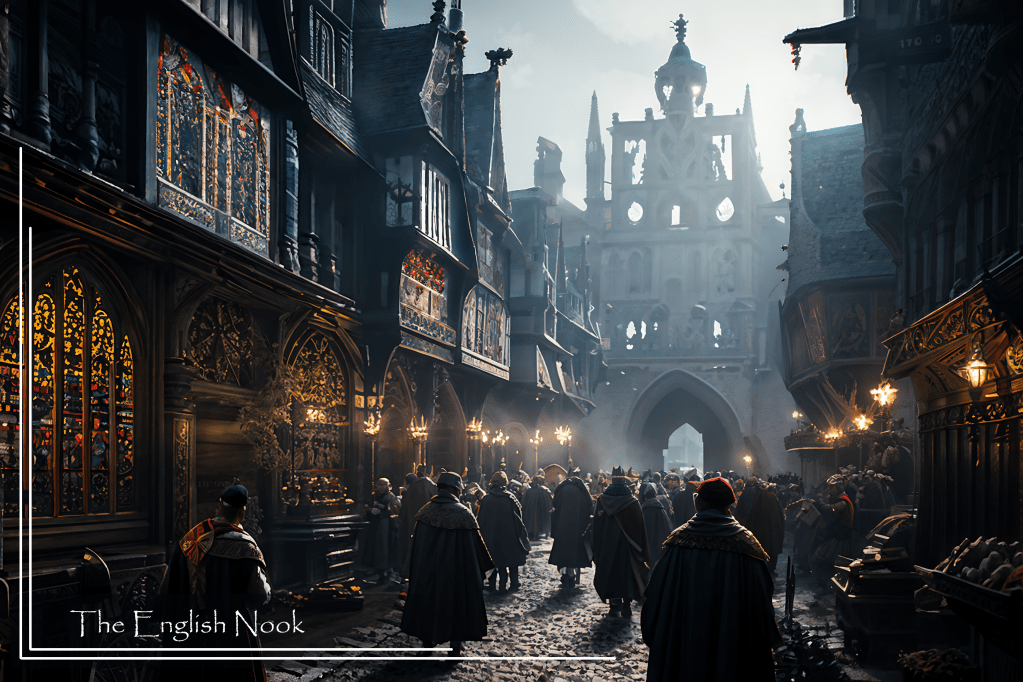

The Birth of Middle English
The emergence of Middle English marks a critical phase in the history of the English language, characterized by the blending of Old English with Norman French. This transformation, sparked by the Norman Conquest of 1066, created a language that would bridge the gap between the Anglo-Saxon past and the Early Modern English of Shakespeare’s time.
Blending of Old English and Norman French:
Before the Norman Conquest, Old English, with its Germanic roots, was the primary language of England. It had a complex grammatical structure and a vocabulary largely derived from Anglo-Saxon origins. However, the arrival of the Normans, who spoke a dialect of Old French, introduced a new linguistic influence that reshaped English profoundly. The upper classes spoke Norman French, while the common people continued to use Old English. Over time, these languages began to intermingle. The result was Middle English, which retained Old English’s grammatical framework but incorporated a vast number of French loanwords. For example, the Old English word “house” coexisted with the French-derived “mansion,” highlighting the linguistic duality of the period.
Simplification of Grammar:
Middle English also witnessed a significant simplification of grammar. The intricate system of noun declensions in Old English, which indicated case, gender, and number, gradually disappeared. Instead, word order and prepositions became more crucial for conveying meaning, a shift that mirrors Modern English usage. Additionally, verb conjugations became more regular, reducing the complexity of the language and making it more accessible to a broader population.
Regional Dialects and Their Influence:
One of the defining features of Middle English was its regional diversity. With no standardized language, different regions developed distinct dialects, each influenced by local linguistic traditions. For instance, Northern dialects retained more Norse elements due to the Viking presence, while Southern dialects were heavily influenced by Norman French. These regional variations are vividly reflected in the works of Geoffrey Chaucer, who wrote in the London dialect. This dialect eventually became the basis for what would evolve into Standard English, largely due to London’s growing political and economic influence.
Literary Contributions and Standardization:
The emergence of Middle English coincided with a literary renaissance. Authors like Geoffrey Chaucer, William Langland, and the anonymous poet of Sir Gawain and the Green Knight were pivotal in showcasing the versatility and richness of Middle English. Chaucer’s The Canterbury Tales is particularly significant, as it not only captured the speech of various social classes but also helped to standardize Middle English. His use of the London dialect, coupled with the popularity of his works, contributed to the gradual unification of the language.
Social Dynamics and Language Use:
The evolution of Middle English was not just a linguistic phenomenon but also a reflection of social dynamics. The blending of Old English and Norman French mirrored the integration of Anglo-Saxon and Norman cultures. Language use became a marker of social status, with French dominating the courts and legal systems, while Middle English gained prominence among the common people. Over time, as the distinctions between the ruling elite and the populace blurred, so did the linguistic divide, leading to the widespread adoption of Middle English.
Example Text
Here’s a different Middle English example, followed by its Modern English translation:
Middle English (from Geoffrey Chaucer’s The Wife of Bath’s Tale):
“Experience, though none auctoritee
Were in this world, is right ynogh for me
To speke of wo that is in marriage:
For, lordynges, sith I twelf yeer was of age,
Thonked be God that is eterne on lyve,
Housbondes at chirche dore I have had fyve.”
Modern English Translation:
“Experience, though there were no written authority
In this world, is quite enough for me
To speak of the woe that is in marriage:
For, my lords, since I was twelve years of age,
Thanked be God who lives eternally,
I have had five husbands at the church door.”
Explanation:
This excerpt illustrates the characteristic spelling, vocabulary, and syntax of Middle English. Chaucer’s The Wife of Bath’s Tale provides a window into the colloquial speech of the time and showcases the merging of Old English structures with the influx of French vocabulary.
To Sum up
The emergence of Middle English was a transformative period in the history of the English language. It represents a linguistic fusion that enriched the vocabulary, simplified the grammar, and laid the foundation for Modern English. By blending Old English and Norman French, Middle English evolved into a language capable of expressing the complexity of medieval society and its literature. This period of linguistic convergence and cultural integration set the stage for the vibrant and dynamic language we speak today, demonstrating the enduring impact of historical events on language evolution.
Middle English was the melting pot where conquest, culture, and language blended to forge the foundation of modern English.
Learn More About:
- Middle English: The Norman Conquest to Chaucer (1150-1500 AD)
- The Impact of the Norman Conquest: Shaping the English Language and Beyond
- The Linguistic Landscape of Middle English: Regional Diversity and Constant Evolution
- The Literary Legacy of Chaucer: Father of English Literature
If you’ve read everything, please consider leaving a like, sharing, commenting, or all three!
YOU WILL ALSO LIKE:





 The English Nook
Leave a comment