Comprehensive Introduction
Learning a new language can be a challenging yet rewarding journey. One of the foundational aspects of mastering a language is understanding and using adjectives effectively. Adjectives are words that describe or modify nouns, providing more detail and specificity in communication. In Spanish, as in many languages, adjectives play a crucial role in everyday conversation, literature, and media.
This guide aims to introduce you to a list of common Spanish adjectives and their opposites, along with example sentences and translations. Understanding these pairs not only expands your vocabulary but also enhances your ability to describe people, places, and things more vividly and accurately.
Importance of Learning Adjectives and Their Opposites
- Enhanced Communication: Adjectives allow you to add nuance and detail to your descriptions, making your conversations richer and more engaging.
- Improved Understanding: Knowing common adjectives and their opposites helps you comprehend spoken and written Spanish better, as these words frequently appear in everyday language.
- Cultural Insight: Language is deeply intertwined with culture. By learning adjectives, you gain insight into how Spanish speakers perceive and describe the world around them.
- Practical Application: Whether you are traveling, working, or building relationships in Spanish-speaking environments, a strong grasp of adjectives enables you to express yourself more clearly and effectively.
A Brief History and Cultural Insight on Common Adjectives
Nuevo (New) / Viejo (Old)
- Historical Context: The concept of new versus old is deeply rooted in human experience, representing change and continuity. “Nuevo” and “viejo” can describe objects, experiences, and even relationships.
- Cultural Note: In many Spanish-speaking countries, tradition is valued, and “viejo” can have a positive connotation, indicating something cherished and time-honored.
Alto (Tall) / Bajo (Short)
- Historical Context: The use of height as a descriptor is universal. In Spanish-speaking cultures, height can often be associated with various social and cultural attributes. For example, historically, being tall was sometimes associated with nobility and strength.
- Cultural Note: Height can be a significant characteristic in many Spanish-speaking countries, where phrases like “alto y fuerte” (tall and strong) are common in descriptions.
Grande (Big) / Pequeño (Small)
- Historical Context: Size has always been a fundamental descriptor in human communication. In literature, “grande” and “pequeño” are frequently used to convey not just physical size but also importance or value.
- Cultural Note: In Spanish culture, the phrase “Mi casa es tu casa” (My home is your home) reflects the importance of hospitality, regardless of whether the home is “grande” or “pequeño.”
Rápido (Fast) / Lento (Slow)
- Historical Context: Speed has always been a critical factor in human development, from ancient travel methods to modern transportation. “Rápido” and “lento” describe more than just movement; they can indicate efficiency or progress.
- Cultural Note: In many Spanish-speaking cultures, there’s a saying, “El que mucho corre, pronto para” (He who runs much, stops soon), emphasizing the value of taking one’s time and the potential pitfalls of rushing. This reflects a cultural appreciation for a balanced pace of life.
Caliente (Hot) / Frío (Cold)
- Historical Context: Descriptions of temperature are essential for survival and comfort. Historically, these adjectives were crucial in describing climates, food, and even emotions.
- Cultural Note: The emotional connotations of “caliente” and “frío” are significant in Spanish. “Caliente” can describe passion or anger, while “frío” can describe indifference or calmness.
List of Common Spanish Adjectives and Their Opposites
Nuevo (New) / Viejo (Old)
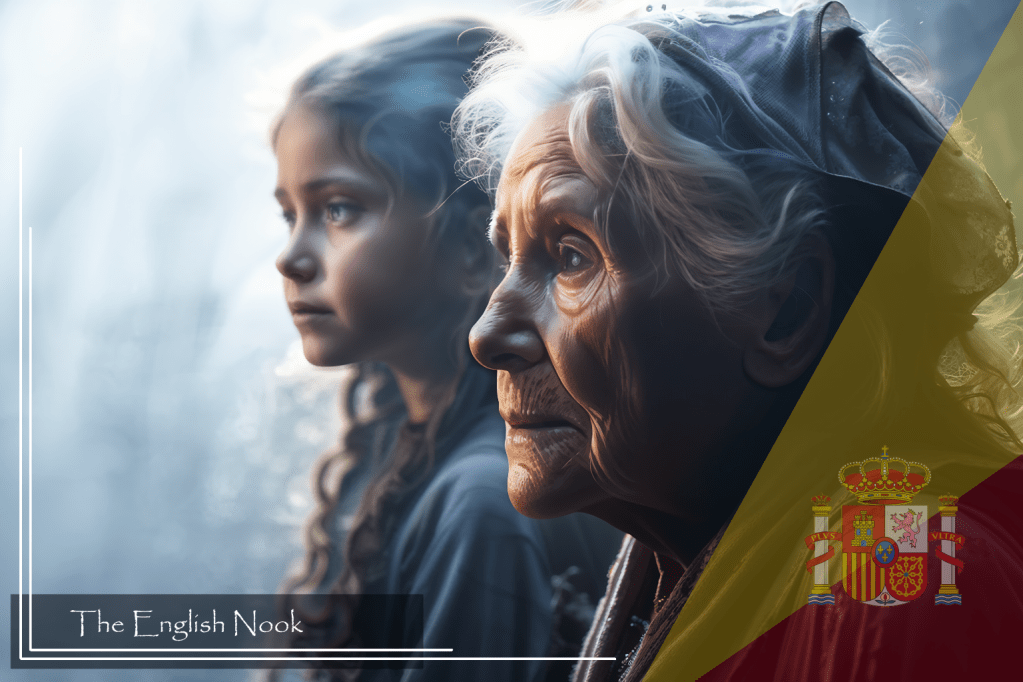
- Example: La niña es joven, pero la mujer es vieja.
- Translation: The girl is young, but the woman is old.
- Alto (Tall) / Bajo (Short)
- Example: Juan es alto, pero su hermana es baja.
- Translation: Juan is tall, but his sister is short.
Grande (Big) / Pequeño (Small)
- Example: La casa es grande, pero el jardín es pequeño.
- Translation: The house is big, but the garden is small.
Rápido (Fast) / Lento (Slow)
- Example: El tren es rápido, pero el autobús es lento.
- Translation: The train is fast, but the bus is slow.
Caliente (Hot) / Frío (Cold)
- Example: El café está caliente, pero el té está frío.
- Translation: The coffee is hot, but the tea is cold.
Feliz (Happy) / Triste (Sad)
- Example: Ella está feliz porque pasó el examen, pero su amigo está triste.
- Translation: She is happy because she passed the exam, but her friend is sad.
Limpio (Clean) / Sucio (Dirty)
- Example: La cocina está limpia, pero el baño está sucio.
- Translation: The kitchen is clean, but the bathroom is dirty.
Caro (Expensive) / Barato (Cheap)
- Example: Este reloj es caro, pero ese es barato.
- Translation: This watch is expensive, but that one is cheap.
Fuerte (Strong) / Débil (Weak)
- Example: El atleta es fuerte, pero el niño es débil.
- Translation: The athlete is strong, but the child is weak.
Joven (Young) / Viejo (Old)
- Example: Mi perro es joven, pero el gato es viejo.
- Translation: My dog is young, but the cat is old.
Understanding and using adjectives effectively allows for more precise and vivid descriptions in Spanish. By learning both common adjectives and their opposites, you can enrich your vocabulary and improve your ability to communicate clearly and expressively. This foundational knowledge is a stepping stone to mastering the nuances of the Spanish language.
Unlock the power of vivid and precise expression in Spanish—master these adjectives and elevate your communication to new heights! Dive in and see your fluency flourish!
If you’ve read everything, please consider leaving a like, sharing, commenting, or all three!
Need some help with your Spanish journey? Go to the contact area and send me a message; I’ll get back to you as soon as possible!
YOU WILL ALSO LIKE:






 The English Nook
Leave a comment