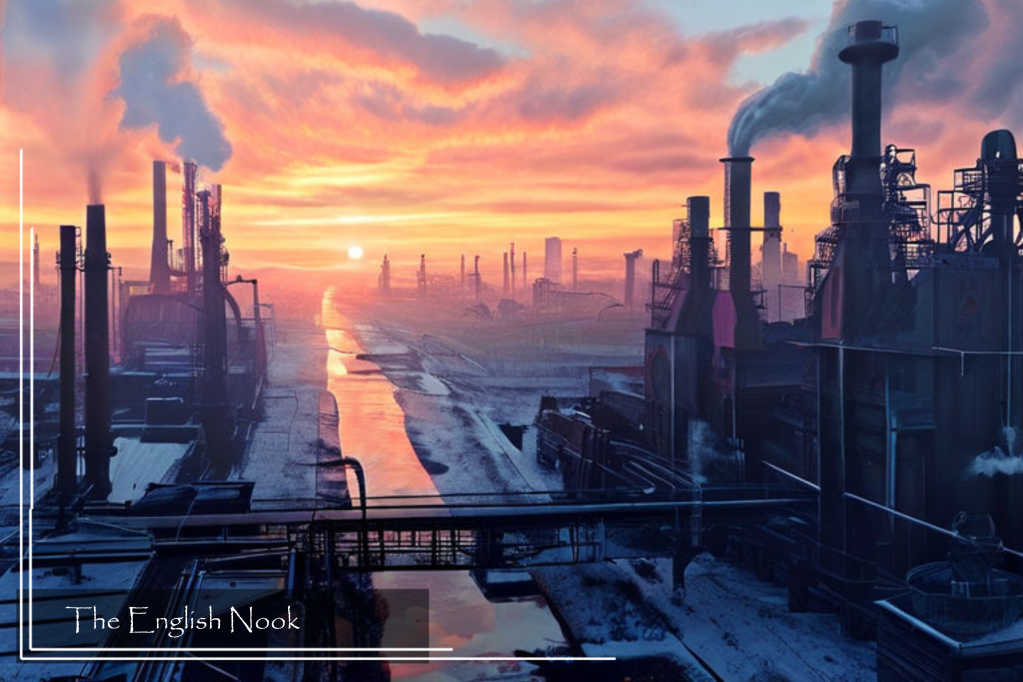

From Industrial Revolution to Digital Domination
Late Modern English, spanning from the onset of the Industrial Revolution in the 18th century to the dynamic landscapes of the 21st century, stands as a testament to the enduring evolution of language in the face of profound historical shifts. This period witnessed a confluence of pivotal events that reshaped not only the socio-economic fabric of society but also the very contours of the English language itself. As the wheels of industry turned and the British Empire unfurled its reach across continents, English found itself propelled to new frontiers, becoming a global force of communication, commerce, and culture.
The Industrial Revolution, with its mechanized marvels and transformative technologies, heralded a new era of human endeavor. It was a time of steam engines and spinning jennies, of factories and urbanization, where the rhythms of life quickened and old certainties gave way to the relentless march of progress. Yet, amidst the clatter of machinery and the surge of industrial might, a quieter revolution was underway within the realm of language.
With the proliferation of printing presses and the rise of literacy rates, the written word assumed newfound significance. Standardization became imperative, leading to the publication of seminal works such as Samuel Johnson’s monumental dictionary, which not only cataloged the vast tapestry of the English lexicon but also sought to impose order upon its sprawling expanse. Spelling and grammatical conventions were codified, laying the groundwork for a more uniform linguistic landscape.
Meanwhile, the expansive tendrils of the British Empire reached every corner of the globe, carrying with them the language of Shakespeare and Milton. English became the lingua franca of administration, trade, and governance, leaving an indelible imprint on the cultures and tongues it encountered. From the bustling streets of colonial outposts to the remote hinterlands of distant continents, the language took root, evolving and adapting to the diverse environments it inhabited.
The march of progress was not confined to the realm of industry alone. Scientific inquiry burgeoned, yielding a torrent of new discoveries and innovations that demanded linguistic expression. From the arcane jargon of physics and chemistry to the precision of medical terminology, English absorbed a wealth of scientific and technical vocabulary, expanding its lexical boundaries to encompass the frontiers of knowledge.
Yet, even as English spread its wings across the globe, it remained intimately entwined with the cultural and literary currents of its homeland. From the Romantic poets who extolled the beauty of nature to the modernist writers who grappled with the existential angst of a rapidly changing world, literature served as a mirror to society, reflecting its hopes, fears, and aspirations.
As the 20th century dawned and the world hurtled towards an uncertain future, English stood poised at the forefront of a new age of globalization and technological innovation. The advent of the internet and digital communication further accelerated the language’s ascent, transforming it into a truly global medium of exchange and discourse.
In tracing the trajectory of Late Modern English, we uncover not only the contours of historical change but also the resilience and adaptability of a language that continues to shape and be shaped by the world around it. From the clangor of the industrial workshop to the ethereal realms of cyberspace, English endures as a living testament to the enduring power of human expression.
In the realm of Late Modern English (1700-21st Century), the Industrial Revolution served as a transformative force not only in economic and social realms but also in the evolution of the English language itself. Here are some additional insights into this fascinating period:
- Standardization and Dictionaries: With the rise of printing presses and increased literacy, there was a growing need for standardized language forms. This led to the publication of influential dictionaries, such as Samuel Johnson’s “A Dictionary of the English Language” (1755). These dictionaries not only aimed to define words but also played a crucial role in standardizing spelling and grammar conventions.
- Grammatical Rules: As literacy rates rose and education became more widespread, there was a greater emphasis on codifying grammatical rules. Grammar guides and textbooks became prevalent during this period, contributing to the standardization of English grammar.
- Scientific and Technical Terminology: The Industrial Revolution spurred unprecedented advancements in science, technology, and industry. This influx of new concepts and discoveries necessitated the creation of a vast array of scientific and technical terms. English absorbed terms from fields such as physics, chemistry, engineering, and medicine, enriching its vocabulary and adapting to the needs of a rapidly changing world.
- Global Influence: The expansion of the British Empire during this period had profound implications for the spread of the English language. British colonialism led to English becoming the dominant language in regions across the globe, from North America and Australia to parts of Africa and Asia. The language served as a tool of administration, commerce, and cultural exchange, leaving a lasting legacy in the form of English-based pidgin and creole languages.
- Literary and Cultural Developments: Late Modern English witnessed a flourishing of literature and cultural expression. From the Romantic poets of the 18th and 19th centuries to the modernist writers of the early 20th century, English literature reflected the societal upheavals, technological advancements, and shifting worldviews of the time. Innovations in literature, theater, and the arts contributed to the richness and diversity of the English language.
- Globalization and Technological Innovation: In the latter part of the 20th century and into the 21st century, English solidified its status as a global lingua franca, driven by globalization and technological innovation. The internet, in particular, has played a pivotal role in connecting people around the world and facilitating the spread of English as the dominant language of communication in various domains, including business, academia, and digital media.
A Living Testament to Human Resilience and Adaptability
In summary, Late Modern English represents a remarkable and dynamic era of linguistic evolution, intricately woven into the fabric of history through industrialization, colonial expansion, cultural exchange, and technological advancements. This period not only transformed the language but also reflected the profound shifts in human experience and understanding.
As English adapted to the challenges and opportunities presented by an ever-changing world, it showcased a remarkable resilience, embracing new influences and ideas from diverse cultures. This adaptability has not only enriched its vocabulary and grammar but has also ensured that English remains a relevant and vital means of communication across the globe.
Today, as we navigate an increasingly interconnected world, English stands as a testament to human creativity and innovation. It serves as a bridge, connecting people from all walks of life and fostering understanding in a complex, multicultural landscape. The language continues to evolve, inspiring future generations to express their thoughts, dreams, and aspirations in a shared linguistic space.
Ultimately, Late Modern English is more than just a collection of words; it is a living testament to our collective journey, reflecting our shared history and aspirations while paving the way for a vibrant future of communication and connection.
From steam engines to smartphones, English powers the world!
If you’ve read everything, please consider leaving a like, sharing, commenting, or all three!
YOU WILL ALSO LIKE:





 The English Nook
Leave a comment